

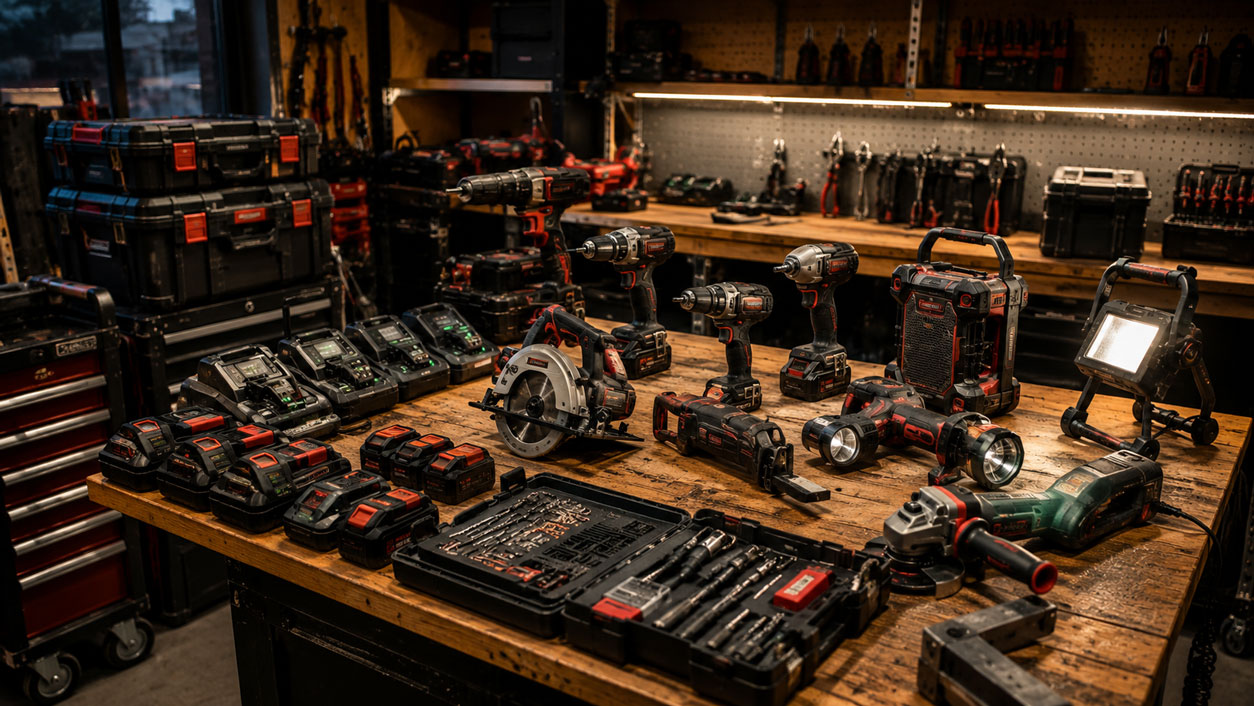
Many tradespeople are no longer buying tools one at a time without considering the wider system around them. Cordless workflows have changed how contractors think about long-term investment, compatibility, and daily site organisation. A single good drill or impact driver is no longer enough to shape purchasing decisions across an entire setup.
Many contractors now consider compatible tool accessories, charging systems, storage solutions, and future expansion opportunities before committing to a cordless platform long term. As manufacturers continue expanding their cordless ranges, ecosystems are increasingly influencing how professionals build their tool setups in 2026.
What a Tool Ecosystem Actually Means
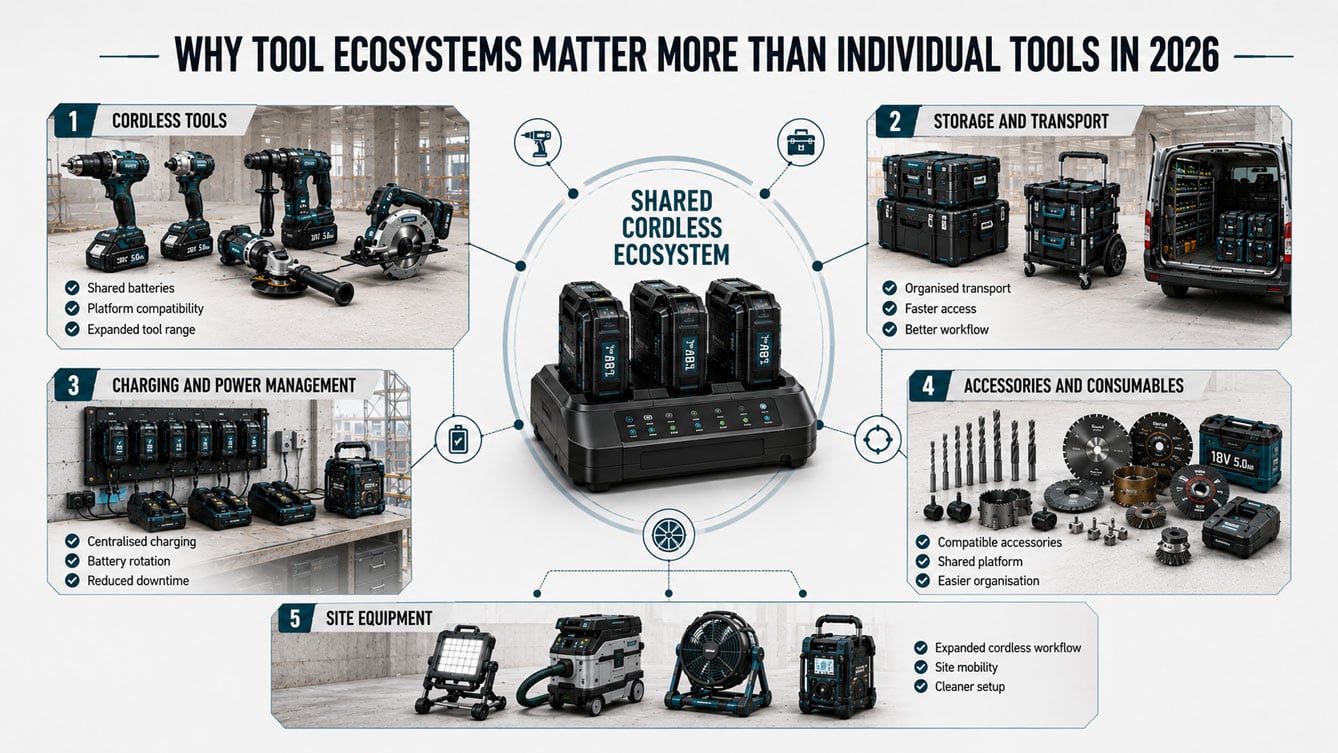
A tool ecosystem is the wider platform surrounding cordless equipment rather than the individual tool itself. This usually includes shared batteries, chargers, storage systems, lighting, extraction equipment, and compatible accessories designed to work together within the same range.
Years ago, cordless platforms were relatively small. Most tradespeople used them mainly for drills, drivers, and a few handheld tools. That has changed quite a bit. Modern cordless ecosystems now stretch across construction, woodworking, engineering, landscaping, and site management equipment.
The result is that tradespeople are increasingly investing in complete systems rather than isolated purchases.
Why Tradespeople Are Thinking Beyond Single Tool Purchases
A powerful tool may still matter, but contractors are increasingly considering the bigger picture before buying into a platform. Buying separate tools across multiple ecosystems often creates complications later with chargers, storage, transport, and battery compatibility.
Many tradespeople now think more strategically about how equipment fits into daily workflows. This becomes particularly important for contractors carrying large cordless setups between jobsites every day.
The wider ecosystem now influences:
- Battery compatibility
- Transport and organisation
- Charging routines
- Future expansion options
This shift is changing how long-term purchasing decisions are made across many trades.
The Cost of Running Multiple Battery Platforms
Running several cordless platforms at once often sounds manageable at first. Over time, though, it can become frustrating and expensive. Different chargers, incompatible batteries, duplicated accessories, and extra storage requirements all begin adding complexity to the workday.
Transporting multiple charging systems between sites also creates additional clutter within vans and workshops. Battery rotation becomes harder to manage, particularly during busy periods where several high-demand tools are running simultaneously.
Many contractors eventually simplify their setups by consolidating around one or two main cordless ecosystems rather than constantly mixing platforms.
How Battery Platforms Influence Tool Choice
Battery platforms now play a major role in tool selection. In many cases, tradespeople will choose a tool that fits their existing ecosystem even if another model performs slightly better in isolated testing.
That might sound surprising at first, but it makes sense operationally. Shared batteries improve flexibility across the working day and reduce the need to carry additional charging equipment.
This becomes even more important as cordless systems continue expanding into:
- Concrete equipment
- Outdoor power equipment
- Lighting systems
- Extraction systems
- Specialist trade tools
The battery platform increasingly acts as the foundation for the wider workflow rather than simply powering individual tools.
Why Storage Systems Are Becoming Part of the Ecosystem
Storage systems are now closely connected to cordless workflows. Organisation, transport, and accessibility all affect productivity on busy sites, particularly when contractors are carrying larger cordless setups than they were a decade ago.
Modern modular storage boxes and tool trolleys are increasingly designed to integrate with batteries, chargers, accessories, and cordless equipment for easier transport and organisation. This allows contractors to move complete working setups around sites more efficiently.
Well-organised storage also reduces wasted time searching for equipment, consumables, and charging accessories throughout the working day.
The Role of Chargers and Power Management
Charging routines are now becoming part of standard site planning. Larger cordless setups require structured battery rotation to avoid downtime during demanding work.
Fast charging systems have improved significantly, helping reduce waiting times between uses. Contractors running larger cordless platforms also tend to build charging areas into workshops, vans, and temporary site setups.
Power management is becoming increasingly important because cordless systems now support far more equipment than they once did. What started with drills and drivers has expanded into extraction systems, lighting, cutting equipment, and outdoor tools.
How Ecosystems Improve Workflow Efficiency
The biggest advantage of a well-planned ecosystem is usually workflow efficiency rather than outright power. Compatible systems remove friction from everyday site operation.
Benefits often include:
- Faster setup and pack-down
- Easier transport between jobs
- Better organisation onsite
- Reduced downtime managing incompatible equipment
The overall workflow becomes more streamlined because equipment is designed to work together rather than operating as isolated pieces of kit.
Why Larger Tool Ecosystems Appeal to Professional Trades
Professional users often prefer larger ecosystems because they provide more flexibility long term. Once contractors commit to a platform, they usually want access to as many compatible tools and systems as possible.
This is one reason manufacturers continue expanding their cordless ranges aggressively. Brands such as Milwaukee, Makita, Bosch, DeWALT, and HiKOKI are all pushing beyond traditional hand tools into extraction, storage, site lighting, outdoor equipment, and specialist trade applications.
For many professionals, the size and depth of the ecosystem now matters just as much as individual tool performance.
The Impact of Cordless Expansion Across Trades
Cordless systems are now being used across far more industries and applications than before. Construction sites, workshops, landscaping projects, and maintenance environments are increasingly relying on battery-powered equipment for everyday work.
This expansion now covers:
- Concrete drilling and demolition
- Mechanical and fabrication work
- Joinery and woodworking
- Landscaping and grounds maintenance
- Mobile site lighting and extraction systems
Improved battery performance and broader equipment ranges are continuing to push cordless adoption further across the trades.
The Downsides of Ecosystem Lock-In
There are disadvantages to ecosystem commitment as well. Once contractors invest heavily into a cordless platform, switching brands becomes expensive because existing batteries, chargers, and storage systems may no longer remain compatible.
Not every manufacturer performs equally across every product category either. Some ecosystems may offer excellent woodworking equipment but weaker outdoor ranges, or vice versa.
This sometimes forces tradespeople to compromise on individual tool preferences in order to maintain wider compatibility across the rest of the setup.
How Manufacturers Are Competing Through Ecosystems
Manufacturers are now competing heavily on ecosystem size rather than relying purely on tool performance. The wider platform surrounding the equipment has become one of the biggest differentiators in the cordless market.
Brands continue expanding into:
- Storage systems
- Site lighting
- Dust extraction
- Outdoor power equipment
- High-demand trade tools
Modern cordless site lighting and power equipment now form part of much wider cordless ecosystems designed around mobility, organisation, and full-site workflow support.
This competition is likely to continue increasing as cordless adoption expands further across professional trades.
Why Tool Buying in 2026 Looks Different
Tool purchasing decisions are becoming more strategic than they once were. Contractors are increasingly planning future expansion before purchasing new equipment rather than focusing only on immediate requirements.
Workflow efficiency, storage compatibility, charging management, and long-term organisation now influence purchasing decisions alongside power and specifications.
In many cases, the wider ecosystem surrounding the tool matters more than the tool itself.
The Future of Tool Ecosystems
Cordless ecosystems will probably continue expanding rapidly over the next few years. Better battery technology, faster charging systems, and wider equipment ranges are already pushing cordless setups into more demanding environments.
Manufacturers are also investing heavily in:
- Smart charging systems
- Integrated storage platforms
- Connected site equipment
- Improved mobility across jobsites
As these systems evolve, ecosystems are likely to become even more central to professional site workflows.
A Well Planned System Saves More Than Time
Tool ecosystems are now shaping how tradespeople organise equipment, manage workflow, and plan long-term investment. Batteries, chargers, storage systems, lighting, accessories, and extraction equipment all contribute to how efficiently a cordless setup operates onsite.
For many professionals, the goal is no longer simply owning the most powerful individual tool. The focus is increasingly shifting toward building reliable systems that reduce friction across the working day and support future expansion more effectively.
The wider ecosystem has become one of the most important factors influencing tool purchasing decisions in 2026.
FAQ's
Q1: What is a cordless tool ecosystem?
A1: A cordless tool ecosystem is a connected platform of compatible tools, batteries, chargers, storage systems, and accessories designed to work together within the same range.
Q2: Why do tradespeople prefer staying within one battery platform?
A2: Using one battery platform simplifies charging, transport, storage, and equipment compatibility across multiple tools and applications.
Q3: Are tool ecosystems more cost effective long term?
A3: In many cases, yes. Shared batteries, chargers, and accessories can reduce duplication and improve overall workflow efficiency over time.
Q4: What are the downsides of ecosystem lock in?
A4: Switching brands becomes more expensive once contractors invest heavily into batteries, chargers, and compatible equipment within one platform.
Q5: Why are storage systems becoming part of cordless ecosystems?
A5: Storage systems now help organise batteries, tools, accessories, and chargers together, improving transport and efficiency across busy jobsites.