


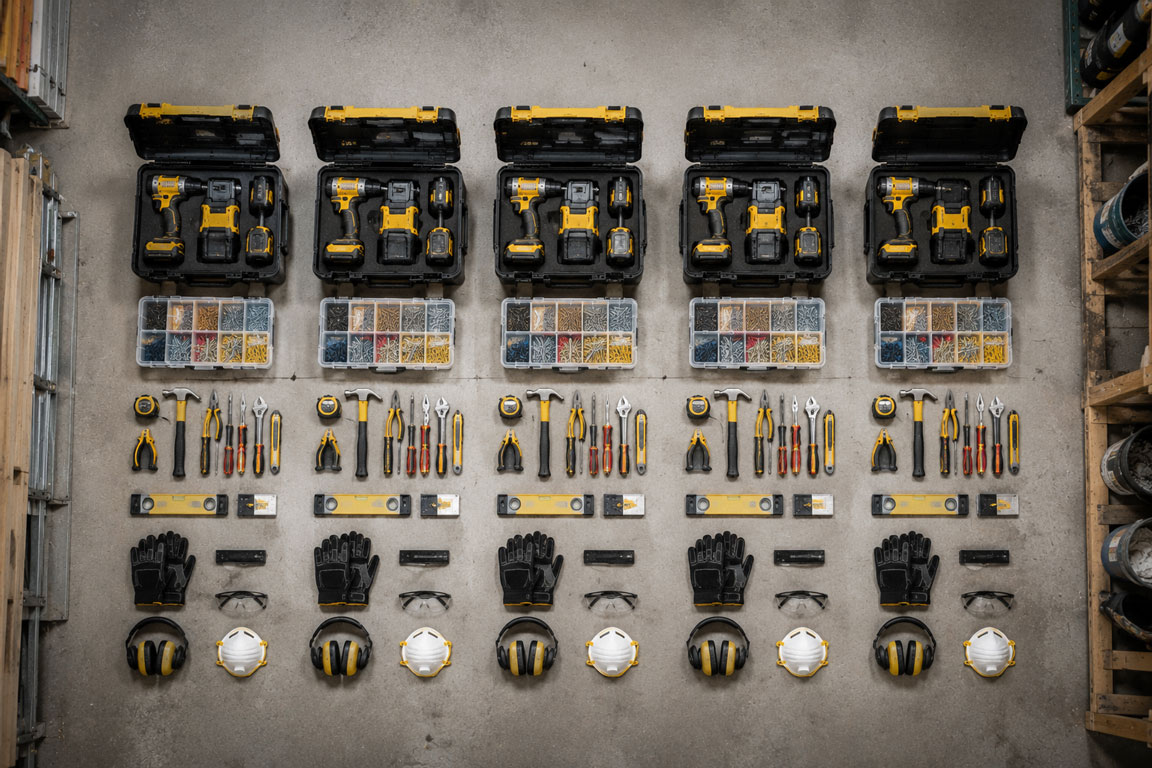
Growth changes how tools are managed on site. What works for one or two people starts to break down as more workers join, especially when individuals bring their own power tools and preferred setups. Over time, this creates inconsistency, slows jobs down, and makes it harder to maintain a reliable standard of work.
Standardising tool kits solves that problem. It creates a consistent way of working, reduces wasted time, and makes it easier to scale without losing control of quality or efficiency.
Why Standardising Tool Kits Matters
When every team member uses a different setup, small inefficiencies start to appear. Tools are not where people expect them to be, equipment gets shared or borrowed, and time is lost adjusting to different layouts. These issues are easy to overlook on a small scale, but they become more noticeable as the team grows.
A standardised approach removes that friction. Everyone knows what tools are available, where they are stored, and how they are used. This improves workflow, supports consistent results, and makes it easier to move between jobs without disruption.
Identifying Your Core Tool Requirements
Standardisation starts with defining what every worker actually needs. This means focusing on tools that are used regularly across most jobs, rather than trying to account for every possible task.
The goal is to separate essential tools from specialist equipment. Essential tools should be included in every kit, while specialist tools can be shared or assigned when required. This keeps kits practical and avoids unnecessary weight or duplication.
Clarity at this stage makes the rest of the process easier. Without it, standardisation becomes inconsistent from the start.
Building a Standard Core Kit
Once the requirements are clear, the next step is to build a core kit that applies across the team. This kit should cover the tools needed for day-to-day work while remaining simple and easy to manage.
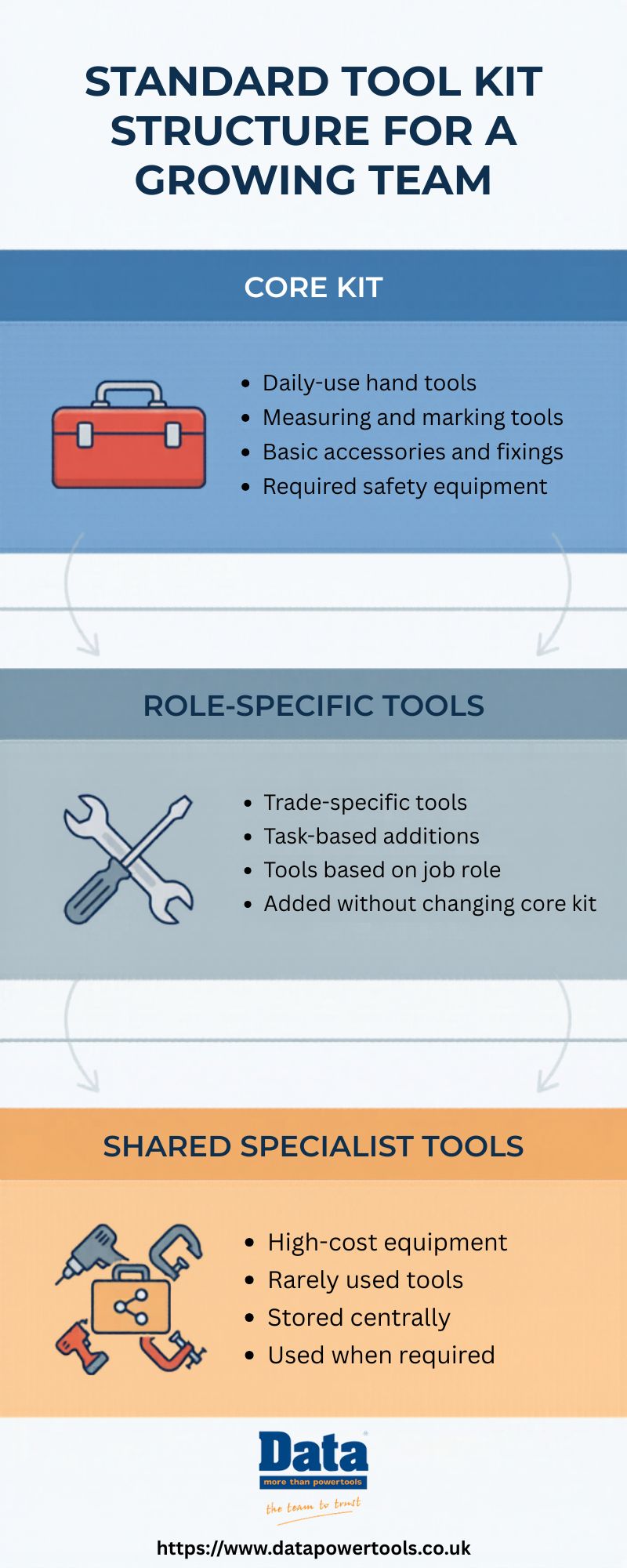
A typical core kit will include:
- Core hand tools used on most jobs
- Basic measuring and marking tools
- Frequently used accessories and fixings
- Any required safety equipment
The aim is not to create a complete solution for every task, but to establish a reliable foundation that supports most work without constant adjustment.
Allowing Flexibility Without Losing Structure
Standardisation does not mean every kit has to be identical in every detail. Different roles will require different tools, and there needs to be room for that.
The key is to keep the core consistent while allowing controlled variation where needed. For example, electricians, carpenters, and plumbers will each need additional tools specific to their work. These can be added on top of the standard kit without changing the overall structure.
Too much flexibility weakens the system. Too little makes it impractical. The balance sits in keeping the essentials fixed while allowing role-based additions.
Choosing One Platform for Power Tools
One of the biggest inefficiencies in growing teams comes from mixing multiple tool platforms. Different batteries, chargers, and systems create unnecessary complications and slow down work on site.
Standardising on a single platform reduces that friction. It allows batteries to be shared, simplifies charging setups, and makes replacements more straightforward. It also reduces the amount of equipment that needs to be carried and managed.
Consistency at this level has a direct impact on efficiency, especially on larger or more complex jobs.
Standardising Tool Storage and Layout
How tools are stored is just as important as which tools are included. Using consistent tool storage systems across the team makes it easier to organise equipment, locate tools quickly, and maintain a structured setup on every job.
When storage is standardised, workers can move between kits without having to adjust to different layouts. This reduces time spent searching for tools and helps maintain a steady workflow throughout the day.
A consistent layout also makes it easier to check kits, restock items, and keep everything organised over time.
Creating a Repeatable Kit Setup System
For standardisation to work long-term, it needs to be repeatable. Every new team member should receive the same setup, built in the same way, with the same structure.
This can be supported with simple checklists that define what each kit should include and how it should be organised. These checklists do not need to be complex, but they should be clear enough that anyone can follow them without guesswork.
A repeatable system removes variation and ensures that standards are maintained as the team grows.
Training the Team to Follow the System
Even the best system will fail if it is not followed. Standardisation needs to be supported through clear communication and consistent training.
Team members should understand not just what the setup is, but why it exists. This helps build consistency in how tools are used, stored, and maintained. It also makes onboarding new workers easier, as expectations are already defined.
Consistency comes from behaviour as much as it does from equipment.
Managing Replacements and Stock
Tools wear out, get damaged, or go missing. How replacements are handled has a direct impact on whether the system stays consistent.
Replacing tools like-for-like helps maintain standardisation. Random substitutions introduce variation and slowly break down the structure that has been put in place. Keeping a small amount of spare stock also helps avoid delays when replacements are needed.
Tracking common issues, such as frequent failures or losses, can highlight areas where the system needs adjustment.
Common Mistakes When Standardising Tool Kits
There are a few common issues that can weaken a standardised setup if they are not addressed early.
- Allowing too much variation between kits
- Overcomplicating the system with unnecessary tools
- Ignoring feedback from the team using the kits daily
- Mixing multiple tool platforms without clear reasoning
- Failing to maintain consistency over time
Avoiding these mistakes keeps the system practical and easier to manage as the team grows.
Scaling the System as Your Team Grows
A good standardised setup should scale naturally. New kits should be built using the same structure, without the need to redesign the system each time someone joins the team.
Documentation should be kept up to date, and any changes should be applied consistently across all kits. This ensures that growth does not introduce new inconsistencies.
Scaling should reinforce the system, not weaken it.
Refining Your Approach Over Time
No setup is perfect from the start. Over time, patterns will emerge that show what works and what does not.
Tools that are rarely used can be removed from core kits, while frequently used items can be repositioned for better access. Feedback from the team is valuable here, as it reflects real-world use rather than assumptions.
Refining the system keeps it practical, efficient, and aligned with how work is actually carried out.
FAQs
Q1: Should every worker have exactly the same tools?
A1: Not necessarily. A core set of tools should be consistent across the team, but role-specific tools can be added where needed.
Q2: How do you balance standardisation with personal preference?
A2: Keep the core kit fixed and allow limited flexibility for trade-specific tools, rather than allowing complete variation.
Q3: Why is using one power tool platform important?
A3: It simplifies battery management, reduces equipment duplication, and improves efficiency on site.
Q4: How do you manage tool loss or damage across a team?
A4: Replace tools like-for-like where possible and keep spare stock available to maintain consistency.
Q5: How often should tool kits be reviewed?
A5: Review them regularly, especially as workloads change or inefficiencies start to appear, to keep the system effective.