


Cabinet work rarely happens in one place. Cutting often starts in the workshop, fitting happens on site, and final adjustments are made in tight spaces where power access is limited. That shift between environments is where tool choice starts to affect both speed and finish quality.
Cordless woodworking tools remove many of those constraints. When the same tools can move from bench work to installation without changing setup, the workflow becomes more consistent. The focus stays on accuracy and fit rather than managing cables, repositioning equipment, or working around limited access.
Understanding Workflow Challenges in Modern Woodworking
Woodworking jobs rely on a sequence of tasks that build on each other. Small inaccuracies early on can carry through to fitting and assembly, where they become more difficult to correct.
- Cutting panels cleanly and to size
- Adjusting components to suit site conditions
- Aligning joints accurately during assembly
- Maintaining consistency across repeated work
Delays tend to come from rechecking measurements, correcting poor cuts, or adjusting components that do not fit first time.
Where Traditional Setups Create Limitations
Corded tools still work well in controlled environments. Limitations become more obvious once work moves onto site.
- Restricted movement when working in fitted areas
- Time lost setting up power across different locations
- Increased risk of damaging finished surfaces with cables
- Interruptions when switching between tools
Using tools outside their intended purpose also creates unnecessary rework, especially when accuracy is critical.
Role of Cordless Tools in a Connected Workflow
A cordless setup allows each stage of the job to flow without interruption. Movement between tasks becomes easier, and tools can stay close to the work area.
- Move between cutting, fitting, and assembly without resetting
- Keep workflow consistent across different environments
- Reduce downtime between adjustments
- Maintain similar handling across multiple tools
This becomes more noticeable on repeat work such as kitchens, wardrobes, and fitted units where consistency matters across every component.
Using a Cordless Jigsaw for Controlled Cutting
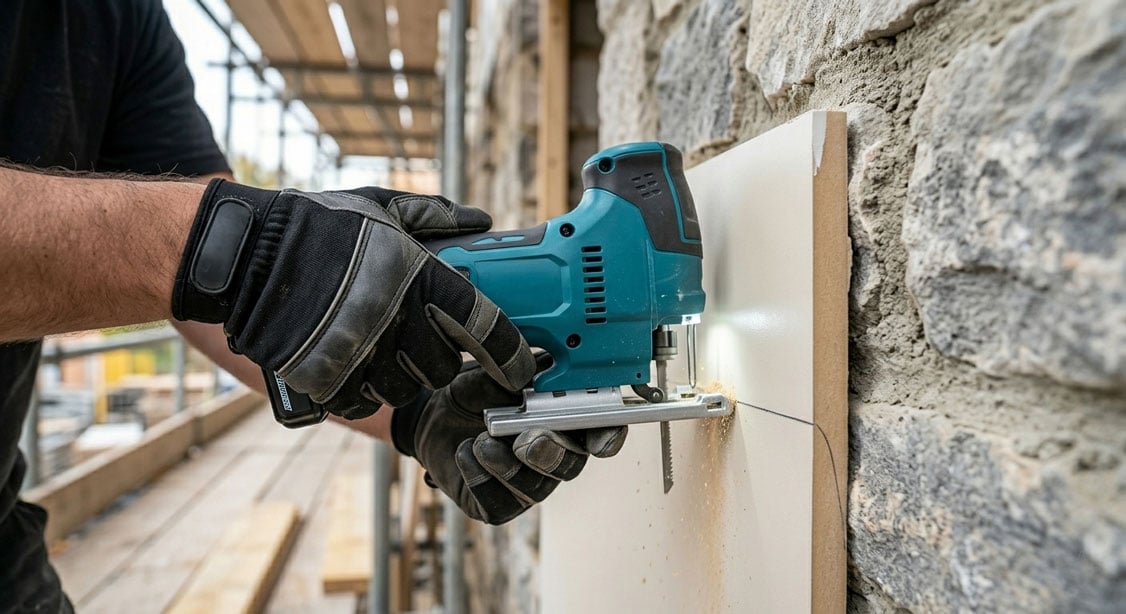
Jigsaws are used where control is more important than speed. They handle curves, cut-outs, and detailed shaping that cannot be achieved with larger saws.
Clean results depend on blade choice, feed rate, and proper support. This is particularly important when working with laminated boards or veneered panels where tear-out needs to be controlled.
Recommended Product
Makita DJV182RTJ 18V LXT Brushless Jigsaw With 2x 5Ah Batteries
This model is suited to regular workshop and site use where consistent performance is required across a range of materials. It handles repeated cuts through MDF, plywood, and hardwood without losing control, which makes it reliable for cabinet panels, worktops, and shaped components.
It is particularly useful when working on kitchen installations or fitted furniture where multiple identical cuts are needed. The brushless motor helps maintain steady cutting speed, which reduces the risk of uneven edges when working across thicker material or layered boards.
This is the type of jigsaw that can stay in use throughout the job, from initial cutting through to final adjustments, without needing to swap tools.
Recommended Product
Makita DJV184Z 18V LXT Brushless Jigsaw Body Only
This option is better suited to lighter work and on-site adjustments. It offers improved control in tighter spaces, which is useful when scribing panels to uneven walls, cutting around fixtures, or making corrections during installation.
It works well when the focus is on accuracy rather than power. Tasks such as trimming end panels, adjusting filler pieces, or working inside fitted units are where this tool fits best.
It is a practical choice for tradespeople who need a jigsaw that can be handled comfortably in confined areas while still delivering clean, controlled cuts.
Using a Cordless Planer for Surface Preparation
Planers are used to refine components rather than shape them from scratch. Most tasks involve trimming doors, easing edges, or bringing surfaces flush during installation.
Controlled material removal is key. Taking off too much in one pass can affect the final fit, especially on finished pieces.
Recommended Product
Makita DKP181Z 18v Brushless Planer 82mm (Body Only)
This planer is suited to repeat work where consistency is important across multiple components. It performs well when trimming cabinet doors, adjusting filler panels, or preparing timber edges for a clean, flush finish.
It is particularly useful when working with hardwood or dense sheet material, where maintaining a steady cut is important to avoid uneven surfaces. The consistent output allows for controlled passes, which helps when working to tight tolerances across a full install.
This makes it a strong option for jobs where several components need to match exactly without variation in finish.
Recommended Product
Makita DKP180Z 18v LXT Cordless Planer Body Only
This model is better suited to general site adjustments and day-to-day tasks. It is useful when quick corrections are needed, such as easing a sticking door, trimming a panel slightly, or adjusting timber that has shifted during installation.
It works well as a go-to planer kept close during fitting stages. Instead of returning to the workshop for small adjustments, it allows changes to be made on the spot, which keeps the job moving.
This is the type of tool that gets used frequently in short bursts across the day, supporting workflow rather than interrupting it.
Using a Cordless Biscuit Jointer for Accurate Assembly
Assembly depends on alignment. Even small inconsistencies can affect how panels sit and how joints come together during fixing.
Biscuit jointing provides a simple and repeatable method for aligning components, especially in cabinet and furniture work where panels need to remain level and evenly spaced.
Recommended Product
Makita DPJ180Z 18v Biscuit Jointer (Body Only)
This tool is used during the assembly stage to keep components aligned before fixing or clamping. It is particularly useful when joining cabinet panels, shelving units, or furniture sections where alignment affects the final finish.
It allows for consistent slot placement, which helps ensure panels sit flush without shifting during glue-up. This reduces the need for correction after assembly and improves overall build quality.
It is well suited to repeat work where multiple joints need to be cut accurately and quickly, helping maintain consistency across larger builds such as kitchen units or fitted storage.
Combining Tools Across Real Job Scenarios
These tools are used together across different stages of the job rather than in isolation.
- Jigsaw for shaping and detailed cutting
- Planer for adjustment and surface finishing
- Biscuit jointer for alignment and assembly
In a kitchen installation, panels are cut and shaped first, adjusted on site to suit walls and floors, then aligned and fixed into position. Each tool supports the next stage without overlap.
In furniture making, repeatability becomes more important. Using the same cordless setup helps maintain consistency across multiple pieces without resetting equipment.
What to Look for When Choosing Cordless Woodworking Tools
Tool selection should reflect the type of work being carried out rather than focusing only on specifications.
- Battery platform consistency across tools
- Balance and control during extended use
- Suitability for both workshop and site conditions
- Reliable performance across different materials
Working within one battery system simplifies setup and helps maintain consistent handling across all tools.
Practical Outcomes on Site and in the Workshop
A coordinated cordless setup improves how work is carried out day to day. Fewer interruptions mean jobs move forward without delays. Each stage supports the next, which reduces the need for correction and rework.
Accuracy improves, setup time is reduced, and tools can move freely between environments. The result is a more consistent finish and a more efficient workflow across both workshop and on-site work.
FAQ's
Q1: What is the advantage of using cordless tools for cabinet making work?
A1: Cordless tools allow you to move freely between workshop and site without relying on power access. This reduces setup time, keeps tools close to the work area, and helps maintain a consistent workflow across cutting, fitting, and assembly stages.
Q2: When should a jigsaw be used instead of other cutting tools?
A2: A jigsaw is best used for curved cuts, detailed shaping, and adjustments that require control. It is also useful when working in tight spaces where larger saws cannot be positioned safely or accurately.
Q3: How does a biscuit jointer improve accuracy during assembly?
A3: A biscuit jointer helps align panels by creating matching slots for biscuits, which hold components in position during assembly. This improves consistency, reduces movement during glue-up, and helps maintain a flush finish.
Q4: Can cordless planers handle hardwood materials effectively?
A4: Yes, cordless planers can handle hardwood when used correctly. Taking controlled passes and using sharp blades allows for clean, even results without damaging the surface.
Q5: Is it better to use tools from the same battery platform?
A5: Using tools from the same platform simplifies battery management and ensures consistent performance. It reduces the need for multiple chargers and helps maintain a smoother workflow across different tasks.