


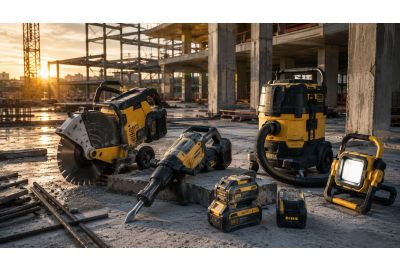
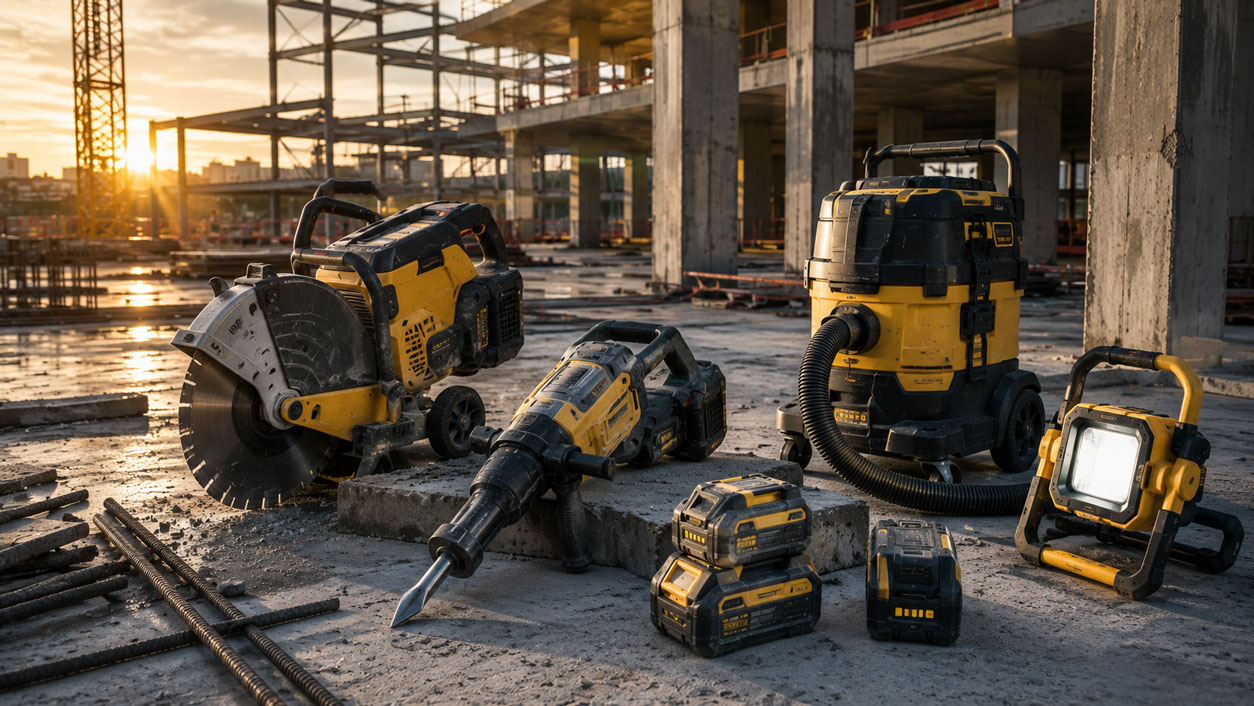
Heavy-duty cordless equipment is evolving rapidly across the global construction industry. What was once limited to drills, impact drivers, and smaller handheld tools is now expanding into demanding applications traditionally dominated by petrol-powered and high-voltage corded equipment. Concrete cutting, demolition work, dust extraction, and large-scale site operations are increasingly becoming part of the cordless conversation.
Recent announcements surrounding the DEWALT POWERSHIFT system at World of Concrete 2026 in Las Vegas have highlighted just how quickly manufacturers are investing in high-output cordless construction equipment. While these product launches were announced in the US market, the wider industry direction is highly relevant to construction projects across the UK where reduced noise, cleaner worksites, improved mobility, and lower emissions are becoming increasingly important.
The growth of larger battery ecosystems such as DeWALT FLEXVOLT also demonstrates how manufacturers are building platforms capable of supporting more demanding professional applications than ever before.
Why Heavy-Duty Cordless Equipment Is Becoming a Major Industry Focus
The construction sector is under increasing pressure to improve efficiency while also addressing practical challenges around site access, emissions, noise restrictions, and operator safety. Cordless equipment offers several advantages that align closely with these changing site requirements.
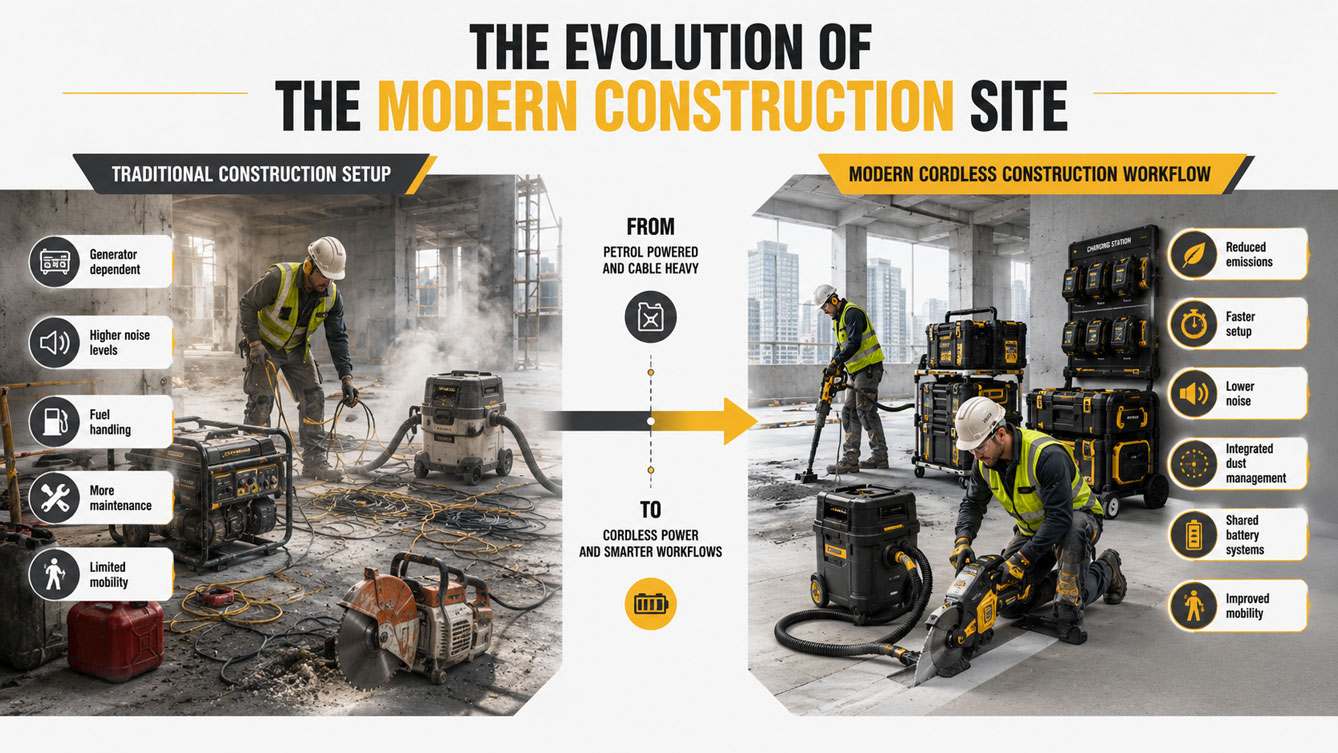
Urban projects, indoor refurbishment work, rail infrastructure, utilities maintenance, and commercial fit-outs often involve environments where petrol-powered equipment can create operational limitations. Fumes, noise levels, extension leads, fuel logistics, and generator placement can all become challenges on busy sites.
Cordless systems are increasingly helping to reduce many of these issues. Removing long cables improves mobility and reduces trip hazards. Battery-powered equipment can also simplify operation in confined areas or partially enclosed environments where ventilation may be more limited.
Manufacturers are responding by developing larger cordless platforms specifically designed for concrete and demolition applications rather than lighter-duty trade work. This shift reflects broader changes across the construction industry where mobility and operational flexibility are becoming increasingly valuable.
What Is DeWALT POWERSHIFT?
DEWALT POWERSHIFT is designed as a high-output cordless construction equipment platform aimed at demanding site applications including demolition, concrete work, and heavy-duty cutting tasks. Unlike smaller cordless systems intended primarily for general trade use, POWERSHIFT focuses on applications that have traditionally relied heavily on petrol engines or high-voltage corded equipment.
The platform was heavily featured during the 2026 World of Concrete trade show where DEWALT introduced additional products designed to expand the system further into concrete and infrastructure applications.
The significance of these announcements goes beyond individual product launches. They reflect a wider industry direction where manufacturers are increasingly investing in cordless infrastructure capable of supporting larger and more demanding workflows.
This shift also suggests growing confidence in battery technology, charging systems, and cordless performance across applications that were once considered unrealistic for battery-powered equipment.
The Significance of the New POWERSHIFT Cut-Off Saw
One of the most notable announcements was the introduction of the DEWALT POWERSHIFT cordless cut-off saw. According to the company, the saw is designed to handle demanding materials including concrete, rebar, and ductile iron while reducing many of the disadvantages associated with petrol-powered cutting equipment.
This category has traditionally relied heavily on petrol-powered tools because of the power demands involved. Cut-off saws used in infrastructure and construction environments often need to deliver sustained cutting performance under difficult site conditions. Battery-powered systems have historically struggled to compete in these applications.
Modern cordless systems are now beginning to challenge that assumption.
The growing development of DeWALT cut-off saws highlights how manufacturers are attempting to reduce noise, eliminate fuel handling requirements, and improve mobility on demanding projects. This could become particularly useful for indoor refurbishment work, rail infrastructure, utilities projects, and urban construction sites where fumes and excessive noise create additional complications.
Cordless cut-off systems may also reduce setup time compared to petrol-powered alternatives, particularly on smaller or fast-moving projects where mobility and operational efficiency are important.
What the New Demolition Hammer Reveals About Cordless Performance
DEWALT also introduced a new cordless demolition hammer delivering up to 45 joules of impact energy while incorporating vibration reduction technology and integrated dust extraction compatibility.
This is significant because demolition equipment has historically remained heavily dependent on corded systems due to the extreme power requirements involved. High-impact demolition work places enormous demands on motors, batteries, and runtime.
The development of more advanced cordless DeWALT demolition hammers suggests that battery systems are now progressing into applications that were once considered impractical for cordless platforms.
Beyond power output itself, there is also growing focus on operator comfort and productivity. Modern demolition tools increasingly incorporate vibration reduction systems designed to reduce fatigue during extended periods of use. On demanding construction sites where operators may use heavy equipment for long periods throughout the day, this can have a meaningful impact on comfort and efficiency.
Cordless demolition equipment also improves mobility. Removing long power cables simplifies movement around active work areas and reduces the need to manage temporary power infrastructure across site.
Why Dust Extraction Is Becoming More Integrated with Modern Cordless Systems
One of the more important aspects of the recent DEWALT announcements was the continued integration between cordless tools and dust extraction systems. The new demolition hammer was introduced with wireless compatibility for DeWALT dust extractors, allowing extraction systems to activate automatically alongside the tool itself.
This reflects a growing trend across the construction industry where manufacturers are increasingly designing complete cordless ecosystems rather than isolated standalone tools.
Dust management is becoming a major priority on modern construction sites, particularly within demolition and concrete applications where airborne particles create health, visibility, and cleanup concerns. Silica dust exposure remains an important issue across the UK construction sector, and many contractors are placing greater emphasis on extraction systems and cleaner workflows.
The development of integrated DeWALT Dust Extractors and wireless activation systems demonstrates how manufacturers are combining cordless mobility with improved safety and cleaner site operation.
Rather than treating dust extraction as a separate process, modern cordless ecosystems increasingly position extraction as part of the wider workflow itself.
What These Developments Mean for UK Construction Sites
Although the recent DEWALT announcements were made in the United States, the wider industry direction is highly relevant to the UK market. Construction sites across the UK are facing many of the same operational pressures that are driving the growth of cordless construction equipment globally.
Noise-sensitive urban environments, indoor refurbishment projects, rail infrastructure work, and utilities maintenance all benefit from cleaner and more mobile equipment solutions. Reduced generator dependency, simplified setup, and improved movement around site can all help improve operational efficiency.
The continued development of larger cordless systems may also encourage more businesses to standardise equipment platforms across teams. Shared battery systems, integrated charging infrastructure, and connected workflows are becoming increasingly important considerations when businesses invest in professional equipment.
This does not mean petrol-powered or corded equipment will disappear entirely. Many heavy-duty applications will still require traditional systems for the foreseeable future. However, the expansion of cordless construction platforms clearly suggests that manufacturers expect battery-powered equipment to continue growing rapidly across demanding professional applications.
The Challenges Still Facing Heavy-Duty Cordless Equipment
Despite the rapid progress being made, heavy-duty cordless construction equipment still faces several practical challenges.
Battery costs remain high, particularly for larger high-capacity systems designed for demanding applications. Runtime can also become a limitation during continuous heavy-duty work, especially on large projects where tools operate for extended periods throughout the day.
Charging logistics are another consideration. Construction sites increasingly require organised charging infrastructure and battery management processes to reduce downtime and keep workflows moving efficiently.
Larger battery systems can also increase overall tool weight. While cordless mobility provides advantages, heavier batteries may affect comfort during prolonged use depending on the application.
There is also the issue of ecosystem investment. Once contractors commit heavily to a particular cordless platform, introducing competing systems can become more difficult and expensive.
Even so, the continued investment from major manufacturers strongly suggests that cordless construction infrastructure will remain a major area of development moving forward.
Where Construction Equipment Could Be Heading Next
Recent announcements surrounding DEWALT POWERSHIFT provide a useful indication of where the construction equipment sector may be heading over the next several years. Manufacturers are no longer focusing solely on smaller cordless trade tools. Increasing attention is now being directed towards larger construction ecosystems capable of supporting demolition, cutting, extraction, and infrastructure workflows.
Battery systems are becoming more powerful, charging systems are becoming faster, and integration between tools and extraction equipment is becoming increasingly sophisticated. Larger cordless platforms may continue reducing dependency on generators while improving mobility and simplifying workflows across many construction environments.
The future of construction equipment is unlikely to become entirely cordless overnight. However, developments such as DEWALT POWERSHIFT clearly show that manufacturers see heavy-duty battery-powered equipment as a major long-term direction for the industry rather than a temporary trend.
FAQ
Q1: What is DEWALT POWERSHIFT?
A1: DEWALT POWERSHIFT is a high-output cordless construction equipment platform designed for demanding applications such as demolition, concrete cutting, and heavy-duty site work.
Q2: Why are manufacturers investing more heavily in cordless construction equipment?
A2: Manufacturers are responding to growing demand for cleaner, quieter, and more mobile construction equipment that reduces dependency on generators, fuel, and extension leads.
Q3: Are cordless cut-off saws suitable for professional construction work?
A3: Modern cordless cut-off saws are increasingly being designed for demanding professional applications including concrete, rebar, and infrastructure work.
Q4: Why is dust extraction becoming more integrated with cordless tools?
A4: Integrated dust extraction systems help improve safety, reduce airborne particles, simplify workflows, and support cleaner operation on construction sites.
Q5: Will cordless equipment eventually replace petrol-powered construction tools completely?
A5: Petrol-powered equipment will still remain important for many demanding applications, but cordless systems are continuing to expand into areas traditionally dominated by petrol and corded tools.