

Choosing a cordless tool platform in 2026 is not a small decision. It is a long term equipment commitment that affects how you work, how much you spend, and how efficiently your kit runs on site. Most tradespeople start with a single purchase, often a set of cordless drills, but that first tool usually leads to a full battery ecosystem.
Once you invest in a platform, you are buying into batteries, chargers, and future tools. Switching later is costly. Mixing systems wastes time. The real question is not which drill is best. It is which platform will still serve you properly five years from now.
Why Platform Strategy Matters More Than a Single Tool
It is easy to focus on the performance of one tool. A combi drill with strong torque figures looks appealing. A compact impact driver feels right in the hand. But once you commit to a battery format, every future purchase ties back to that decision.
A strong cordless platform gives you:
- Shared batteries across multiple tools
- Reduced downtime through battery rotation
- Consistent charging systems
- Lower long term cost per tool
If you buy tools from different brands simply because they are on offer, you end up carrying multiple chargers and incompatible batteries. That slows you down. It also increases your kit cost over time.
The smarter approach is to treat your first purchase as the start of a system, not a one off tool.
Battery Technology in 2026
Battery development continues to move forward. Higher capacity cells, better thermal control, and improved charging speeds are now standard expectations rather than premium extras.
When assessing a cordless platform, pay attention to:
- Amp hour ratings and real world runtime
- High output battery options for demanding tools
- Heat management and overload protection
- Charging speed and smart charging systems
Higher amp hour batteries provide longer runtime, but they also add weight. A 5.0Ah battery is not automatically better than a 3.0Ah battery for overhead work or tight spaces. You need to match battery size to application.
Voltage also matters. Twelve volt systems are compact and suited to lighter tasks. Eighteen volt platforms remain the most common across UK trades. Some manufacturers now offer higher voltage or twin battery systems for heavy duty cutting and grinding.
The key point is compatibility. When you invest in power tool batteries within one platform, you want assurance that future tools will continue to use the same battery interface. Backwards compatibility protects your investment.
Depth of the Tool Range
A cordless platform must go beyond drills and drivers. As your work expands, you will want access to specialist tools without changing battery systems.
A strong platform should include:
- Cordless circular saws for site cutting
- Cordless angle grinders for fabrication and prep work
- SDS plus drills for masonry
- Nailers for finishing and framing
- Outdoor power equipment if your work includes landscaping or property maintenance
If a platform only offers basic tools, you will eventually hit a limit. At that point, you either compromise on performance or introduce a second battery system into your kit.
Look at the manufacturer’s full range, not just their headline products. Are there bare unit options available? Is the range expanding year on year? A deep ecosystem suggests long term support.
Motor Technology and Efficiency
Brushless motors are now standard across most serious cordless platforms. They provide better energy efficiency, reduced heat build up, and longer service life compared to brushed motors.
In practical terms, this means:
- More work per charge
- Less maintenance
- Improved durability under load
Brushless systems also allow more advanced electronic control. That can improve trigger response and reduce kickback in certain tools.
When comparing platforms, check whether the majority of core tools use brushless motors. Entry level brushed tools may reduce upfront cost, but they can shorten runtime and long term durability.
Ergonomics and Jobsite Practicality
Specifications on paper do not tell the full story. Weight balance, grip design, and tool length matter on a busy site.
A well designed cordless platform should offer:
- Compact bodies for tight access
- Balanced weight distribution
- Comfortable grips suited to prolonged use
- Effective vibration control
Dust extraction compatibility is also increasingly important. Many UK sites now expect better dust management, particularly in renovation and commercial environments. If your platform integrates easily with extraction systems, that improves compliance and working conditions.
Durability remains essential. Look for reinforced housings, sealed switches, and clear IP ratings where provided. Tools get knocked about in vans and on scaffolds. They need to withstand that reality.
Charging Infrastructure and Workflow
Battery charging is often overlooked when selecting a platform. Yet it directly affects productivity.
Consider:
- Availability of rapid chargers
- Multi port charging options
- Charge times for common battery sizes
- Compatibility with vehicle charging setups
If you run multiple batteries through the day, a slow charger becomes a bottleneck. Fast charging systems reduce the number of batteries you need to own.
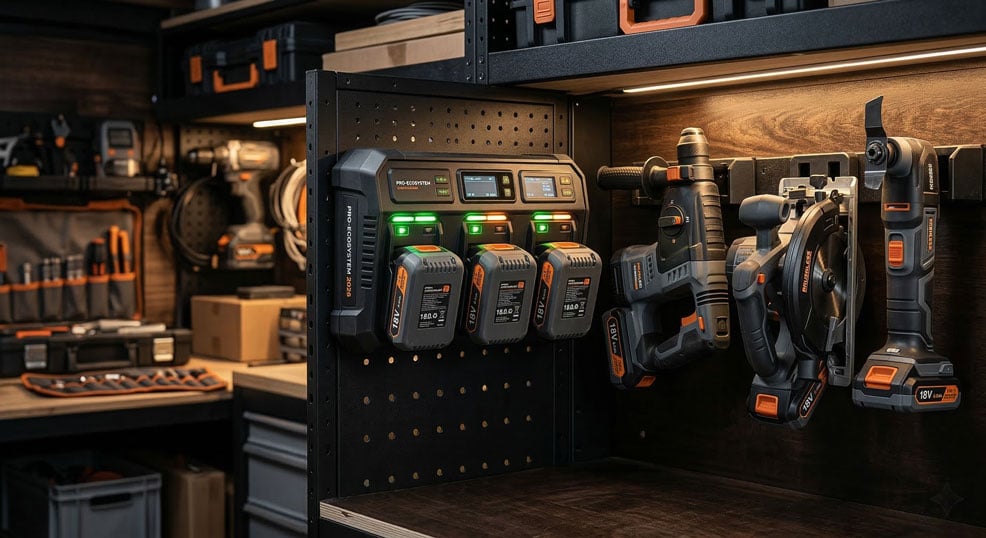
Look at the available battery chargers within the platform. Are there single, twin, and multi port options? Can you mount them in a van racking system? Small details like this can make daily workflow smoother.
A clear battery rotation strategy keeps your tools running without interruption. That only works if the platform supports practical charging infrastructure.
Platform Longevity and Manufacturer Commitment
A cordless tool platform should not feel temporary. Before committing, check how long the battery format has been on the market.
Questions to consider:
- Is the battery interface well established?
- Do newer tools remain compatible with older batteries?
- Are spare parts available in the UK?
- Is warranty support straightforward?
Established brands tend to offer more stable ecosystems. They have larger tool ranges, stronger distribution, and proven long term support.
When browsing cordless power tools by brand, assess the scale of each ecosystem. A broad, mature range usually indicates that the platform will remain supported rather than replaced within a few years.
Cost of Ownership Over Five Years
Upfront kit price can be misleading. The true cost of a cordless platform includes:
- Initial tool kit
- Additional bare tools
- Replacement batteries
- Charger upgrades
Cheaper entry platforms may look attractive at first. But if the battery range is limited or upgrade options are poor, you may end up replacing the entire system sooner than expected.
Calculate the cost of adding three or four additional tools over time. Check the price of replacement batteries. Consider how many batteries you realistically need to keep your workflow uninterrupted.
A strong platform reduces repeated spending. It protects your initial investment by allowing gradual expansion.
Making the Right Decision for Your Trade
There is no single perfect cordless platform for everyone. The right choice depends on the type of work you carry out and how intensively you use your tools.
Ask yourself:
- Do you need compact tools for confined spaces?
- Are you running heavy duty saws and grinders daily?
- Will you expand into specialist tools in the next few years?
- How important is rapid charging to your workflow?
Match platform capability to your trade. A general builder may prioritise range and battery power. A kitchen fitter may value compact size and weight. An apprentice may focus on future expansion potential.
Think long term. Choose a system that grows with your workload rather than one that limits it.
A cordless tool platform is not just a collection of tools. It is the backbone of your daily work. Selecting the right one in 2026 means assessing battery technology, tool depth, charging infrastructure, and long term support as a complete package.
FAQ’s
Q1: Should I stick with one cordless brand?
A1: In most cases, yes. Sticking with one platform allows you to share batteries and chargers across tools. That reduces cost and simplifies workflow. Mixing brands often creates unnecessary duplication.
Q2: Are higher amp hour batteries always better?
A2: Not always. Higher amp hour batteries provide longer runtime but increase weight. For overhead or precision work, lighter batteries may be more practical.
Q3: Is 18V still the best choice in 2026?
A3: For many UK trades, 18V remains the most balanced option between power and portability. Higher voltage systems suit heavy duty applications, while 12V systems are better for lighter tasks.
Q4: How long should a cordless battery last?
A4: With proper care and rotation, a quality battery should last several years. Lifespan depends on usage intensity, charging habits, and storage conditions.
Q5: What is the biggest mistake tradespeople make when choosing a platform?
A5: The most common mistake is focusing on the first tool rather than the long term ecosystem. Choosing based on price alone can lead to compatibility issues and higher costs later.