


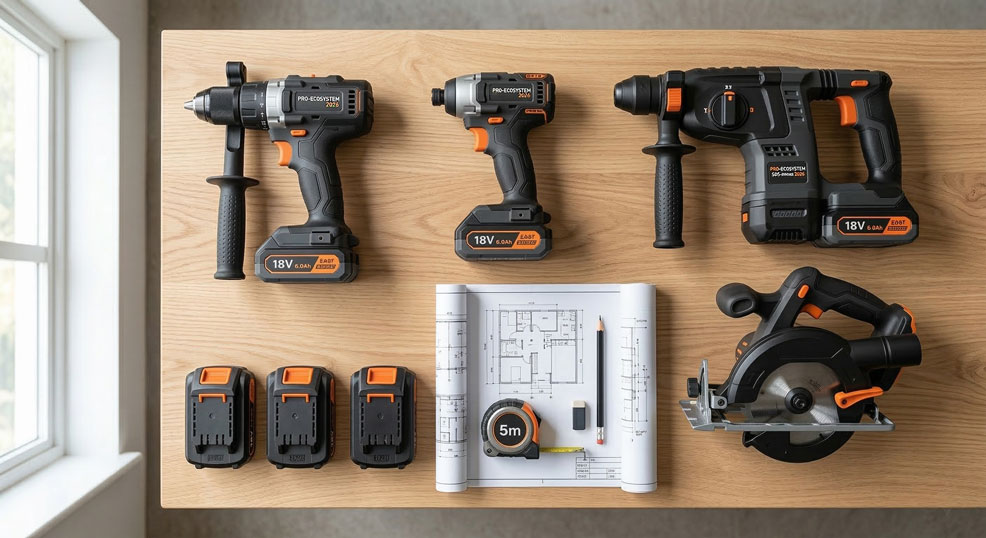
Turning up to site with the wrong kit wastes time. Turning up with too much kit slows you down. An efficient tool loadout sits somewhere in the middle. It gives you what you need to complete the job properly, without dragging half your workshop around in the back of the van.
Owning good tools is one thing. Carrying the right tools, powered by the right batteries, stored in a way that supports your workflow, is something else entirely. Whether you are a builder, electrician, plumber, carpenter, or multi trade contractor, your loadout should reflect the way you actually work, not what looks impressive in a catalogue.
What Makes a Tool Loadout Efficient
An efficient loadout is built around practicality.
It means:
- Carrying tools you use regularly
- Avoiding duplication
- Running a shared battery platform
- Managing weight and space properly
- Storing tools for quick access
Efficiency is not about owning the most tools. It is about reducing friction during the working day. If you constantly return to the van to swap batteries or search for attachments, your setup needs adjusting. If you carry tools that never leave the case, they are adding weight without adding value.
Start by assessing your daily tasks. Which tools genuinely earn their place in your van?
Core Cordless Platform as the Foundation
Most modern loadouts revolve around a cordless platform. Shared batteries reduce clutter and lower long term cost. It also simplifies charging and rotation.
For many trades, the starting point is a set of cordless drills and a reliable impact driver. These two tools cover drilling, fixing, and general site assembly work. From there, expansion becomes easier when everything runs on the same battery system.
Choosing a cordless platform before expanding your kit prevents compatibility problems later. Mixing brands may seem harmless at first, but multiple battery formats quickly complicate charging and storage.
Think of your cordless system as the backbone of your loadout. Every additional bare tool should strengthen that system, not fragment it.
Builder and General Construction Loadout
Builders and general construction trades typically require a broader range of cutting and drilling tools. A balanced loadout might include:
- Combi drill
- Impact driver
- Circular saw
- SDS plus drill
- Angle grinder
Cutting, drilling into masonry, and general fixing all demand different levels of power. Battery capacity planning becomes important here. Heavy duty tools like circular saws and grinders draw more current than drills.
For this reason, a mix of mid capacity and higher output batteries makes sense. Use lighter batteries for drills and heavier packs for high demand cutting tools.
The aim is not maximum power in every tool. It is the right power where it is needed.
Electrician Loadout
Electricians often work overhead or in confined spaces. Weight and balance matter more than headline torque figures.
A typical electrician loadout might include:
- Compact combi drill
- Impact driver
- SDS drill for chasing and fixings
- Oscillating multi tool
- Inspection lighting
Smaller batteries can make more sense here. Reducing weight improves control when working above shoulder height. A compact cordless system that still offers an SDS option keeps the loadout consistent without adding bulk.
Cable pulling tools, testing equipment, and specialist accessories also take space. Keep the power tool side streamlined to maintain overall balance.
Plumber and Heating Engineer Loadout
Plumbers and heating engineers frequently work in tight cupboards, lofts, and under floor spaces. Portability and manoeuvrability are key.
An efficient plumbing loadout may include:
- Combi drill
- Impact driver
- Reciprocating saw
- Compact angle grinder
- Press tool
Cutting pipe and brackets often requires a reciprocating saw, while grinders assist with metal prep. Battery rotation is important when working away from direct power access.
Compact tools with shorter body lengths help when working between joists or inside service voids. A consistent battery platform reduces the number of chargers required in the van.
Carpenter and Joiner Loadout
Carpenters and joiners prioritise precision. Balance, control, and clean cutting are more important than brute force.
A typical loadout could include:
- Impact driver
- Combi drill
- Circular saw or track saw
- Mitre saw
- Nailers
Here, ergonomics matter. A well balanced tool reduces fatigue during repetitive fixing and trimming work. Battery weight should complement the tool, not overpower it.
If you regularly work between site and workshop, consider how tools transfer between environments. Keeping the cordless system consistent across saws and nailers simplifies charging and reduces downtime.
Maintenance and Property Services Loadout
Maintenance contractors often handle varied tasks in a single day. Flexibility is critical.
A practical multi trade loadout might include:
- Drill driver
- Impact driver
- Multi tool
- Compact grinder
- Inspection light
The aim is coverage rather than specialisation. Compact, versatile tools reduce the need to carry large cases for single use tasks.
Because maintenance work can be unpredictable, battery redundancy is important. Carry enough batteries to avoid disruption, but avoid overloading the van with unused spares.
Battery Planning and Charging Strategy
Battery management can make or break an efficient loadout.
Consider:
- How many batteries you realistically use daily
- Charge time versus work time
- Availability of rapid chargers
- Placement of battery chargers within your van
Owning too few batteries creates downtime. Owning too many adds cost and weight. Monitor your usage over a few weeks and adjust accordingly.
Investing in reliable power tool batteries within your chosen platform ensures consistent performance. Rotating batteries properly and avoiding deep discharge extends their lifespan.
Think of batteries as working assets, not accessories.
Tool Storage and Transport Efficiency
Even the best loadout fails if storage is disorganised. Modular tool storage systems allow you to stack, separate, and transport tools logically.
Effective storage should:
- Protect tools from impact
- Allow fast access on site
- Keep batteries and chargers organised
- Fit securely within van racking
A structured storage setup reduces time spent searching for kit. It also protects your investment from unnecessary damage.
Plan your storage around your daily sequence of tasks. Frequently used tools should be the easiest to access.
Safety Equipment That Should Never Be Overlooked
An efficient loadout is not complete without proper protection. Eye protection, hearing protection, gloves, and respiratory protection should travel with your core kit.
Including PPE and safety equipment within your storage system ensures it is always available when needed. Leaving protective gear loose in the van increases the chance it gets forgotten.
Safety equipment is not optional. It should be built into the loadout from the start.
Avoiding Common Loadout Mistakes
Several common mistakes reduce efficiency.
Buying tools outside your main battery platform introduces extra chargers and batteries.
Oversizing batteries for every tool adds unnecessary weight.
Carrying duplicate tools for rare scenarios clutters storage.
Ignoring future expansion limits flexibility.
Review your loadout periodically. Remove tools that do not justify their space. Add tools only when they solve recurring problems.
Building a Loadout That Grows with Your Trade
Your workload will change over time. New contracts, different site requirements, and evolving standards all influence the tools you need.
When evaluating cordless power tools by brand, consider ecosystem strength rather than individual models. A platform with a wide range of compatible tools supports gradual expansion without forcing you to start again.
Start with essentials. Add tools deliberately. Maintain platform consistency.
An efficient tool loadout does not happen by accident. It is built through careful selection, battery planning, and realistic assessment of daily tasks. When done properly, it improves productivity, reduces fatigue, and protects your investment over the long term.
FAQ’s
Q1: How many cordless tools should I carry daily?
A1: Carry the tools you use regularly and one or two that cover common unexpected tasks. Avoid packing rarely used tools that add weight without adding value.
Q2: How many batteries do I realistically need?
A2: Enough to complete your typical working cycle without waiting for recharge. Monitor usage for a few weeks and adjust based on actual demand.
Q3: Should apprentices invest in a full kit immediately?
A3: It is often better to start with a core drill and driver set within a strong platform, then expand gradually as work requirements become clearer.
Q4: Is it better to buy kits or bare tools?
A4: Kits offer value when starting a platform. Once established, bare tools allow targeted expansion without unnecessary duplicate batteries or chargers.
Q5: What is the biggest mistake tradespeople make when building a loadout?
A5: The most common mistake is mixing battery systems and failing to plan long term. That leads to clutter, extra cost, and reduced efficiency.