



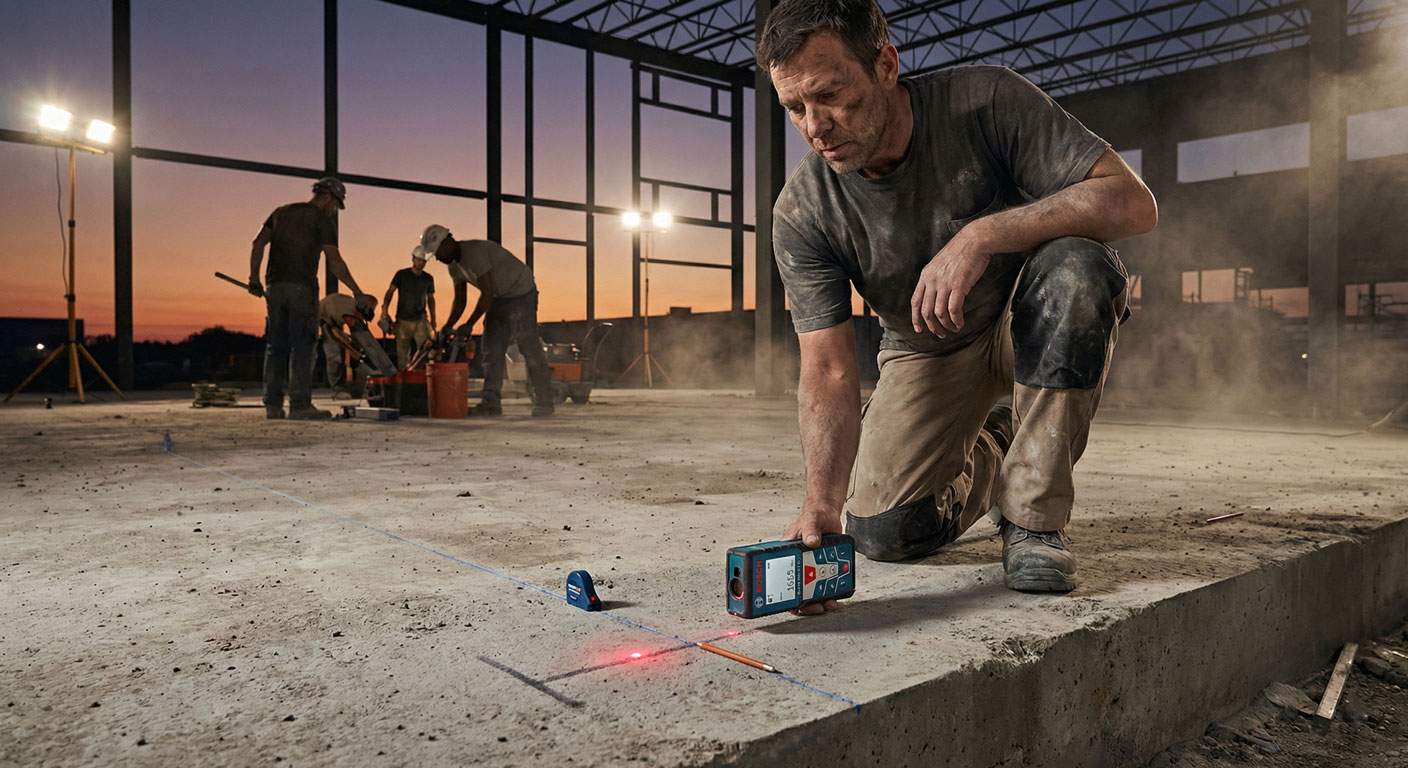
Most layout mistakes are not caused by faulty tools. They happen because accuracy slips over time. Measurements taken early in the day are trusted without being rechecked, reference points drift, and fatigue encourages shortcuts. By the afternoon, small inaccuracies have compounded into visible problems that are difficult and time-consuming to correct.
Modern measuring equipment is capable of very high accuracy, but maintaining that accuracy on site requires more than switching the tool on and trusting the display. Within the range of Bosch intelligent measuring tools, precision is built into the hardware, but consistency comes from how those tools are set up, checked, and used throughout the working day. Staying accurate from first mark to final fix is a process, not a single measurement.
Choosing the Right Measuring Tool for the Job
Accuracy begins with selecting the correct tool for the task. Laser levels are designed to maintain consistent reference lines over distance, making them ideal for layout work that depends on alignment across a space. Distance measurers speed up repetitive checks and reduce manual error when marking out. Angle measurement tools help preserve geometry where layouts depend on precise angles rather than straight runs.
Problems arise when tools are used outside their intended role. Using a distance measurer where a fixed reference line is needed introduces alignment error. Relying on manual tape measurements across long runs increases the chance of cumulative deviation. Choosing the wrong tool does not usually cause an immediate failure, but it creates a foundation for errors that appear later.
A simple rule helps: if consistency matters more than speed, use a reference tool that stays in place. If speed matters more than alignment, use a measuring tool that reduces repetition.
Setting Up Measuring Tools Correctly
Most layout errors are introduced during setup, not during measurement. Rushed placement, unstable mounting, or incomplete levelling allow drift to enter the workflow unnoticed. Once a reference point is compromised, every measurement that follows carries that error forward.
Stable mounting is critical for any layout task that spans time. Using properly set-up tripods for measuring tools reduces vibration, prevents accidental movement, and keeps reference lines consistent even as work continues around them. A tool that is nudged out of position by foot traffic or nearby activity may still appear level, but the reference has already shifted.
Taking the time to confirm level, lock mounting points, and check alignment before starting work is one of the most effective ways to protect accuracy over the course of a long day.
Common Site Conditions That Undermine Accuracy
Real-world sites rarely provide ideal measuring conditions. Uneven surfaces introduce instability. Vibration from cutting or drilling nearby can shift tools gradually. Poor lighting makes alignment marks harder to see and encourages estimation rather than confirmation.
Environmental factors also play a role. Temperature changes can affect materials and introduce subtle movement. Dust and debris interfere with optics and sensors. These issues rarely cause obvious errors in isolation, but combined with rushed setup and fatigue, they erode accuracy steadily.
Human factors matter just as much. Interruptions, time pressure, and multitasking increase the likelihood that checks are skipped and assumptions are made. Recognising these risks allows teams to build simple safeguards into their layout routine.
Maintaining Accuracy Over a Long Day
Accuracy is easiest to maintain in the morning, when attention is high and reference points are fresh. As the day progresses, fatigue sets in and repetition encourages complacency. Measurements are trusted without verification, and small discrepancies are dismissed as insignificant.
The most effective way to prevent drift is to build re-verification into the workflow. Checking key reference points after breaks, after moving tools, or before starting a new phase of work catches errors early. This does not slow progress. It prevents the far greater disruption caused by discovering misalignment after work has progressed.
Accuracy maintained through routine checks costs minutes. Accuracy recovered after failure costs hours.
Calibration and Tool Checks That Actually Matter
Formal calibration is not required for every task, but basic field checks are essential. Verifying a tool against a known reference confirms that it has not been knocked out of alignment or developed an issue during use.
Tools that show inconsistent readings, fail to hold reference lines, or behave unpredictably should be removed from service until verified. Continuing to work with a questionable measurement tool almost always leads to compounded errors and rework.
Knowing when to stop and check is part of professional layout discipline, not a sign of inexperience.
Layout Habits That Reduce Cumulative Error
Consistency is often more valuable than absolute precision. Working from fixed datum points, following a logical measurement sequence, and avoiding unnecessary repositioning of reference tools all reduce the opportunity for error.
Cross-checking critical dimensions before committing to fixes prevents small discrepancies from becoming structural problems. Measuring twice does not mean working slower. It means identifying issues while they are still easy to correct.
Teams that adopt consistent layout habits spend less time correcting mistakes and more time progressing the job.
Transport and Storage Between Tasks
Measuring tools are sensitive instruments. Poor transport and storage undo careful setup work and introduce hidden errors. Tools left loose in vehicles or stored where they can be knocked or contaminated are far more likely to drift.
Protective storage, careful handling, and keeping optics clean preserve accuracy and extend tool life. A tool that arrives on site already compromised cannot deliver reliable results, regardless of its specifications.
Accuracy as a Workflow, Not a Feature
Staying accurate over a long day is about discipline. Good tools support accuracy, but habits protect it. Careful setup, regular verification, consistent handling, and disciplined storage all contribute to reliable layout work.
When accuracy is treated as part of the workflow rather than a feature of the tool, layout errors reduce, rework declines, and productivity improves. Precision becomes repeatable rather than hopeful.
FAQ’s
Q1: How often should measuring tools be checked on site?
A1: Key reference points should be verified regularly, particularly after breaks, tool movement, or environmental changes.
Q2: Do laser levels lose accuracy during the day?
A2: The tool usually remains accurate, but setup drift and environmental factors can affect results.
Q3: What causes cumulative layout errors?
A3: Small setup mistakes and skipped checks that compound across multiple measurements.
Q4: Is calibration needed for everyday site work?
A4: Routine field checks are usually sufficient unless inconsistent readings appear.
Q5: How do environmental conditions affect measuring tools?
A5: Vibration, uneven surfaces, dust, and temperature changes can all undermine accuracy if not managed.