


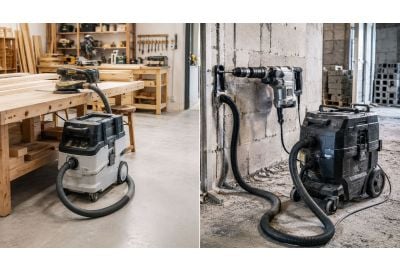
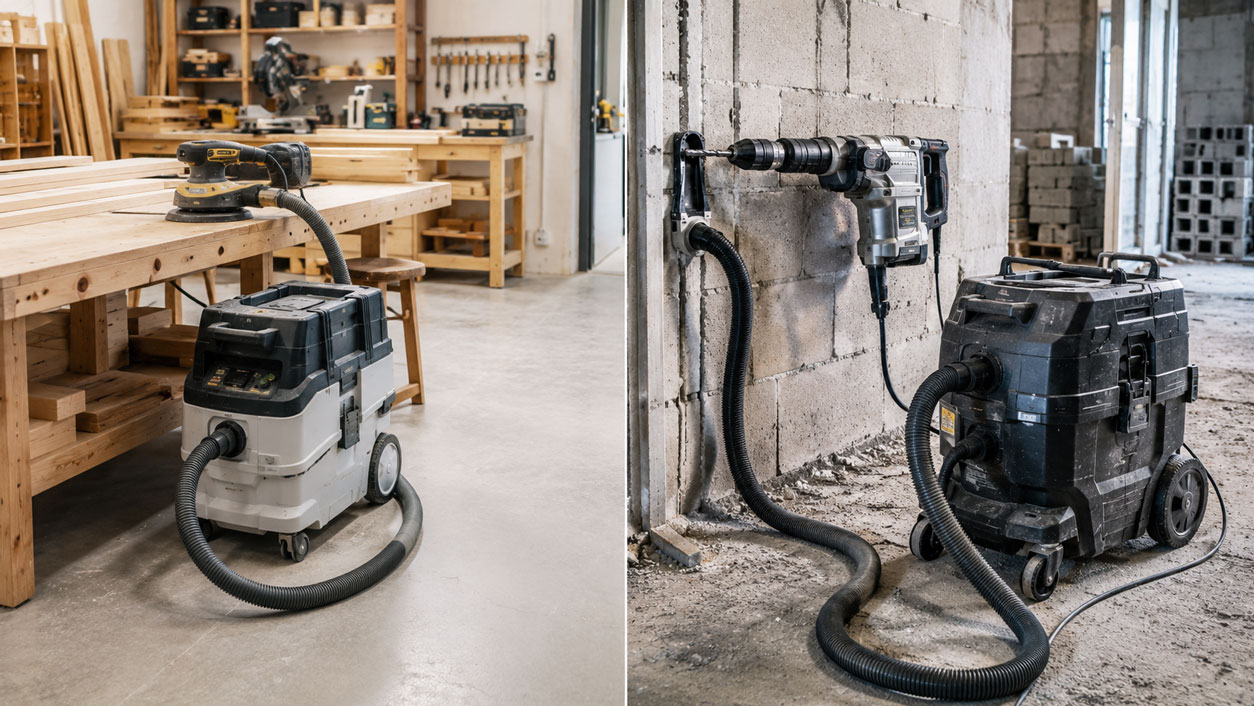
Dust extraction has become a much bigger consideration on modern construction sites. What was once viewed primarily as a housekeeping issue is now recognised as an important part of workplace safety, productivity and equipment protection.
If you're investing in a dedicated dust extraction system for site work, you'll quickly encounter terms such as L Class and M Class. While the names may seem technical, understanding the difference can help you choose an extractor that matches the type of work you carry out and the materials you work with most often.
The right dust extractor is not simply about keeping work areas cleaner. It can also play an important role in controlling airborne particles generated during drilling, cutting, sanding and demolition work.
Why Dust Extraction Standards Matter
Many construction materials produce fine dust particles that become airborne during use. Some settle quickly, while others can remain suspended in the air for extended periods.
The challenge is that dust is often far more harmful than it appears. Fine particles can travel throughout a workspace and may be inhaled long after the visible dust cloud has disappeared.
Dust extraction standards exist to help users select equipment capable of capturing different types of dust effectively. Rather than treating all dust as equal, extraction classes recognise that some materials present greater risks than others.
This classification system helps contractors, tradespeople and site managers choose suitable extraction equipment for specific applications.
What Is an L Class Dust Extractor?
L Class extractors are generally designed for lower-risk dust applications.
They provide a good level of filtration and are commonly used in workshops, maintenance environments and construction settings where lower-hazard dusts are generated.
Typical applications may include:
- General workshop cleaning
- Softwood dust collection
- Plaster dust
- General site debris
- Light renovation work
For many users, an L Class extractor provides an effective solution for routine cleaning and dust collection tasks.
They are often more affordable than M Class units and can be perfectly suitable where higher filtration levels are not required.
What Is an M Class Dust Extractor?
M Class extractors are designed to provide a higher level of dust control.
They are commonly chosen by professional contractors working with materials that generate finer or potentially more hazardous dust particles.
Compared with L Class units, M Class extractors typically feature more demanding filtration requirements and additional safety-focused features.
Many professional users favour M Class extractors because they provide greater confidence when carrying out dust-intensive work.
Applications commonly associated with M Class extraction include:
- Concrete drilling
- Wall chasing
- Masonry cutting
- Hardwood sanding
- MDF processing
- Renovation and refurbishment projects
Many modern M Class extractors also incorporate features such as automatic filter cleaning systems, helping maintain consistent airflow during demanding tasks.
Understanding the Health Risks Behind Dust Classifications
The reason dust classifications exist becomes clearer when considering the materials commonly encountered on site.
Wood dust, particularly from hardwoods and engineered timber products, can produce fine particles that remain airborne for extended periods.
MDF creates especially fine dust during cutting and sanding operations. Concrete, mortar and masonry products can generate silica-containing dust that requires careful management.
The issue is not always visible dust.
In many cases, the smallest particles present the greatest concern because they are more likely to remain airborne and be inhaled.
This is why professional dust extraction systems have become increasingly important across multiple trades. Effective extraction helps reduce airborne contamination at the source rather than relying solely on cleanup after the work is complete.
Which Materials Typically Require M Class Extraction?
Many professional contractors choose M Class extraction when working with materials that generate significant volumes of fine dust.
Common examples include:
- Concrete
- Brick
- Mortar
- Stone
- Hardwood
- MDF
- Fibre cement products
Tasks such as drilling anchor holes, cutting channels for services, sanding timber and chasing walls can produce large quantities of airborne dust in a relatively short period.
Because of this, M Class extractors are often viewed as the preferred option for contractors carrying out regular construction and refurbishment work.
The higher filtration performance can make them particularly attractive for users who frequently work indoors or in occupied environments.
M Class vs L Class Dust Extractors Compared
The easiest way to understand the differences is through a direct comparison.
| Feature | L Class | M Class |
|---|---|---|
| Filtration level | Standard dust control | Higher filtration performance |
| Typical users | Workshop and light trade users | Professional contractors |
| Common materials | General dust and debris | Concrete, masonry, MDF, hardwoods |
| Dust-intensive work | Suitable for lighter applications | Better suited to demanding applications |
| Purchase cost | Typically lower | Typically higher |
| Site requirements | Application dependent | Commonly chosen for professional construction work |
While both classes provide effective extraction, M Class models are generally designed for more demanding environments.
Is M Class Always the Better Choice?
Not necessarily.
It can be tempting to assume that buying the highest specification available is always the best approach, but this is not always true.
An M Class extractor may offer greater filtration performance, but it also typically comes with a higher purchase price.
For users who primarily carry out light workshop work, occasional drilling or general cleaning, an L Class extractor may provide everything they need.
The best choice depends on:
- The materials you work with
- How often you generate dust
- The environment you work in
- Your future requirements
Many professionals choose M Class extractors because their work regularly involves materials that create significant amounts of fine dust. Others may find an L Class machine perfectly adequate for their workload.
Building a Complete Dust Management System
A dust extractor is only one part of an effective dust control setup.
Capturing dust at the source is often just as important as the extractor itself. This is where tool-mounted dust control accessories can make a significant difference.
When fitted to compatible tools, shrouds help contain dust close to the point of generation, allowing the extractor to capture more particles before they spread through the working area.
A complete dust management system may include:
- Dust extractors
- Shrouds
- Hoses
- Tool adapters
- Filter systems
- Automatic activation technologies
The more effectively these components work together, the better the overall dust control performance.
How Modern Technology Is Improving Dust Control
Dust extraction technology has developed significantly in recent years.
Modern systems can do far more than simply switch on and collect dust. Some solutions now allow tools and extractors to communicate automatically, reducing unnecessary noise and ensuring extraction starts exactly when it is needed.
Wireless activation systems have become increasingly popular because they improve convenience while helping maintain good dust management practices.
Our article on automatic dust extraction activation technology explores one example of how modern systems are improving dust control on site.
As dust control continues to receive greater attention across the industry, these types of innovations are likely to become increasingly common.
Choosing the Right Extractor for Your Work
Choosing between M Class and L Class extraction starts with understanding the work you do most often.
If your projects primarily involve general maintenance, workshop use and lower-risk dust applications, an L Class extractor may provide everything required.
If you regularly drill concrete, cut masonry, process engineered timber products or carry out refurbishment work, an M Class extractor may be worth considering.
The most important factor is matching the extractor to the materials and environment you encounter on a daily basis.
Taking the time to understand dust classifications can help ensure you invest in equipment that delivers the right balance of performance, practicality and protection for your work.
FAQ's
Q1: What is the difference between M Class and L Class dust extractors?
A1: L Class extractors are generally intended for lower-risk dust applications, while M Class extractors provide higher filtration performance and are commonly used for more demanding construction and refurbishment work.
Q2: Do I legally need an M Class dust extractor?
A2: Requirements depend on the materials, work activities and site-specific circumstances involved. Always ensure your equipment is suitable for the application being carried out.
Q3: Is M Class suitable for wood dust?
A3: Many professional users choose M Class extraction when working with hardwoods, MDF and other engineered wood products that generate fine dust.
Q4: Can I use an L Class extractor for concrete dust?
A4: Suitability depends on the specific application and working environment. Many contractors prefer M Class extraction when carrying out regular concrete and masonry work.
Q5: Why are M Class extractors more expensive?
A5: They typically incorporate higher filtration performance and additional features designed to support more demanding dust control applications.
Q6: What accessories improve dust extraction performance?
A6: Shrouds, hoses, adapters, filters and automatic activation systems can all help improve the effectiveness of a dust extraction setup.