

Impact drivers and impact wrenches are both designed to make fastening easier, but they are built for very different jobs. Because they use a similar impact mechanism and often look alike at first glance, many buyers assume they are interchangeable.
In reality, choosing the wrong tool can make a task unnecessarily difficult or leave you carrying more tool than you actually need.
Whether you're considering modern cordless fastening tools for construction work or looking at heavy-duty fastening equipment for automotive applications, understanding the differences will help you choose the right tool for the jobs you tackle most often.
Why Impact Drivers and Impact Wrenches Are Often Confused
At a glance, impact drivers and impact wrenches appear very similar. Both use a rotating hammer-and-anvil mechanism that delivers rapid impacts while turning. This helps transfer torque more effectively than a standard drill or driver.
The confusion often comes from the fact that both tools are designed to tighten and loosen fasteners. To someone unfamiliar with power tools, they can appear to perform exactly the same role.
The key difference is that they are designed for completely different types of fasteners.
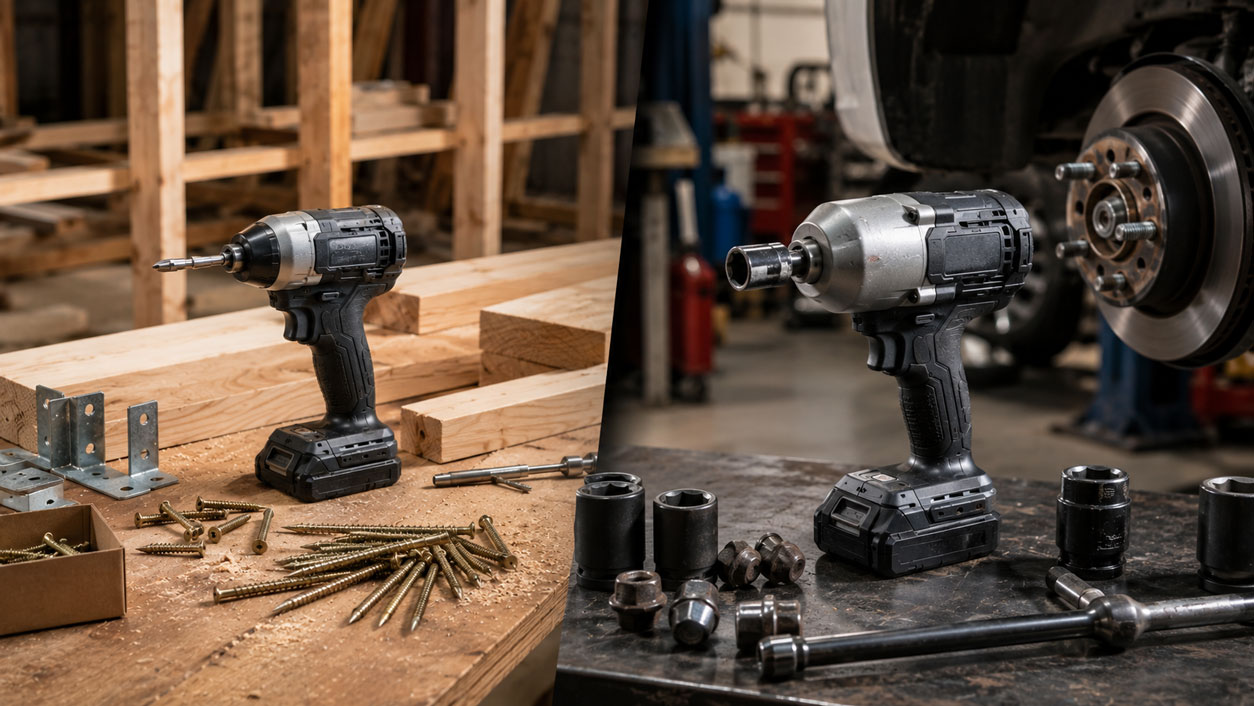
An impact driver is primarily intended for screws and smaller fixings. An impact wrench is designed for nuts, bolts and heavy-duty fastening applications where significantly higher torque is required.
Understanding this distinction is often the easiest way to decide which tool belongs in your toolkit.
What Is an Impact Driver?
An impact driver is one of the most popular cordless tools on construction sites.
Instead of using a conventional drill chuck, it uses a ¼-inch hex collet that accepts screwdriver bits, nut setters and specialist driving accessories.
The internal impact mechanism activates when resistance increases. Rather than relying entirely on motor power, the tool delivers rapid rotational impacts that help drive fasteners with less effort.
Typical applications include:
- Timber screws
- Structural screws
- Decking screws
- Coach screws
- Woodworking fixings
- General construction fasteners
Because the impacts help reduce cam-out and user effort, impact drivers are particularly useful when driving long screws into timber or dense materials.
They have become a staple tool for builders, carpenters, roofers and many other trades.
What Is an Impact Wrench?
An impact wrench is designed for a different category of fastening work.
Instead of a hex collet, it uses a square drive anvil that accepts impact-rated sockets. This allows it to work with nuts, bolts and heavy-duty fasteners that require far more torque than an impact driver can typically deliver.
Most high-torque fastening tools are commonly used for:
- Wheel nuts
- Structural bolts
- Steelwork fixings
- Plant maintenance
- Automotive repairs
- Mechanical assembly work
The design prioritises torque output rather than versatility.
While an impact driver focuses on driving screws efficiently, an impact wrench is built to tighten and loosen larger fasteners that would be difficult or impossible to manage with smaller tools.
Understanding the Difference in Torque Output
Torque is often one of the first specifications buyers compare.
Simply put, torque measures rotational force.
Both impact drivers and impact wrenches generate high levels of torque relative to their size, but the numbers are usually very different.
An impact driver may provide enough torque to drive large construction screws and coach screws with ease. An impact wrench is designed to generate substantially higher torque for loosening stubborn nuts and tightening large bolts.
This does not automatically make an impact wrench the better tool.
A roofing contractor installing timber fixings rarely needs the torque required to remove wheel nuts. Likewise, a mechanic working on suspension components is unlikely to achieve the desired results with a standard impact driver.
The best tool depends on the fasteners being used rather than simply choosing the model with the highest torque figure.
Fasteners Each Tool Is Designed to Handle
Looking at the fasteners involved often makes the choice much clearer.
| Fastener Type | Impact Driver | Impact Wrench |
|---|---|---|
| Wood screws | Yes | |
| Decking screws | Yes | |
| Structural screws | Yes | |
| Coach screws | Yes | |
| Nuts and bolts | Limited | Yes |
| Wheel nuts | Yes | |
| Large structural bolts | Yes |
This comparison highlights why the two tools complement each other rather than compete directly.
Each is designed around a different type of fastening task.
Which Tool Is Better for Construction Work?
For most construction trades, an impact driver is usually the more useful day-to-day tool.
Carpenters, builders and roofers regularly drive hundreds of screws throughout a project. The compact size, lighter weight and excellent fastening performance of an impact driver make it ideal for these environments.
Common applications include:
- Timber framing
- Decking
- Roofing
- Joinery
- Drylining
- General construction work
An impact driver can also be easier to carry throughout the day, particularly when working at height or moving frequently around a site.
This combination of convenience and performance explains why impact drivers have become standard equipment for many construction professionals.
Which Tool Is Better for Automotive and Engineering Tasks?
Impact wrenches dominate in automotive and engineering environments.
Removing wheel nuts, suspension bolts and heavy-duty fixings often requires torque levels beyond the capabilities of an impact driver.
Mechanics rely on impact wrenches because they can:
- Remove seized fasteners
- Speed up repetitive maintenance work
- Reduce manual effort
- Improve productivity in workshops
Beyond automotive work, impact wrenches are widely used in steel fabrication, plant maintenance and industrial environments where large bolts are common.
When torque is the priority, an impact wrench is usually the preferred solution.
Do You Need Both Tools?
Many professionals eventually own both.
The reason is simple: each tool excels at different tasks.
An impact driver is often the first choice for:
- Screws
- Timber fixings
- General construction work
An impact wrench is often the first choice for:
- Nuts
- Bolts
- Mechanical fastening
- Automotive repairs
Rather than replacing one another, the two tools work together.
A contractor who occasionally works on machinery may benefit from owning both. Likewise, mechanics often keep impact drivers available for lighter fastening work while relying on impact wrenches for larger fasteners.
If you're still weighing up the differences between an impact driver and a drill driver, that comparison can also help clarify where each tool fits within a modern cordless toolkit.
The decision comes down to the type of work you perform most often.
Choosing the Right Tool for Your Work
The best choice depends on the fasteners you encounter every day.
If your work involves driving screws into timber, assembling structures or completing general construction tasks, an impact driver will usually provide the versatility and performance you need.
If your workload revolves around wheel nuts, heavy bolts, machinery maintenance or engineering applications, an impact wrench is likely to be the more appropriate option.
Understanding the difference between the two helps avoid overspending on unnecessary torque or buying a tool that struggles with the tasks you need it to perform.
Choosing the right tool is less about buying the most powerful option and more about selecting the one designed for the work in front of you.
FAQ's
Q1: Can an impact driver replace an impact wrench?
A1: Not completely. An impact driver is designed primarily for screws and smaller fasteners, while an impact wrench is intended for nuts, bolts and heavy-duty fastening tasks.
Q2: Can an impact wrench drive screws?
A2: It can in some situations using suitable adapters, but it is generally not the most practical or efficient tool for routine screwdriving.
Q3: Which tool has more torque?
A3: Impact wrenches typically produce significantly more torque than impact drivers because they are designed for larger fasteners.
Q4: Do mechanics need an impact driver?
A4: Many mechanics use impact drivers for lighter fastening tasks, although impact wrenches remain the primary tool for wheel nuts and larger bolts.
Q5: Can I remove wheel nuts with an impact driver?
A5: Some impact drivers may loosen wheel nuts in certain circumstances, but impact wrenches are specifically designed for this type of application.
Q6: Which tool is better for DIY users?
A6: For general DIY projects involving screws and construction tasks, an impact driver is often the more versatile choice.