

If you've been shopping for cordless tools recently, you've probably noticed the word "brushless" appearing everywhere. Manufacturers often highlight brushless motors as a premium feature, and many professional tools now use them as standard.
The challenge is that many buyers know brushless is supposed to be better, but they are not always sure why.
Whether you're investing in a modern cordless drill platform or expanding an existing cordless toolkit, understanding brushless motor technology can help you make more informed buying decisions. It can also explain why some tools cost more than others, even when they appear similar on the surface.
Why Brushless Motors Have Become the New Standard
For many years, brushed motors were the standard choice in power tools. They were reliable, relatively simple and could deliver plenty of power for everyday tasks.
As battery technology improved, manufacturers started looking for ways to get more performance from cordless tools without increasing battery size or weight.
Brushless motors offered a solution.
Today, brushless technology is common across professional cordless platforms from leading manufacturers. In many premium tool ranges, it has become the default option rather than an upgrade.
This shift has not happened because brushless motors are fashionable. It has happened because they offer genuine advantages in efficiency, durability and performance.
How Traditional Brushed Motors Work
To understand the benefits of brushless motors, it helps to look at how brushed motors operate.
A brushed motor uses carbon brushes to transfer electrical current to a rotating component known as a commutator. As the motor spins, the brushes remain in physical contact with the commutator, allowing electricity to flow and generate movement.
The design works well and has been used successfully for decades.
The downside is that the brushes create friction. Friction generates heat and causes wear over time. Eventually, the brushes need replacing, and some energy is lost during the process of transferring power through these contact points.
For occasional users, this may never become a significant issue. For professionals using tools daily, the limitations become more noticeable.
What Makes a Brushless Motor Different
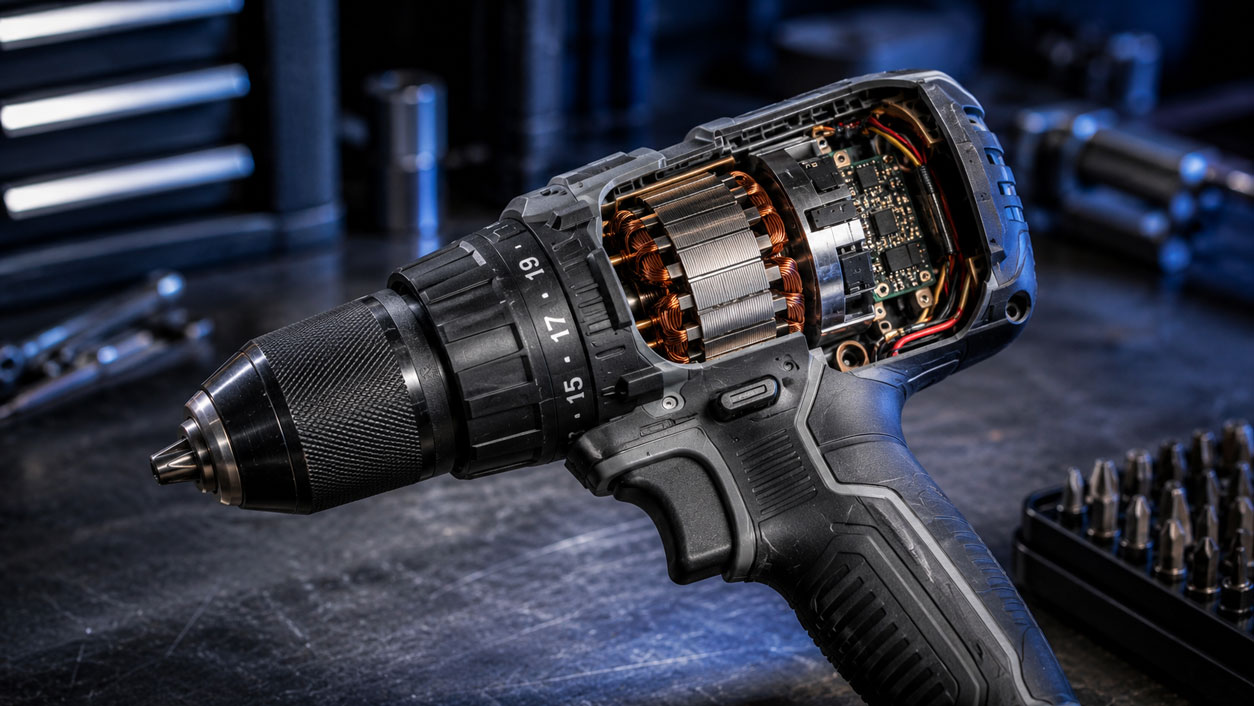
A brushless motor removes the brushes and commutator entirely.
Instead of relying on physical contact to control motor operation, electronic controllers manage the flow of electricity. Sensors monitor the motor and adjust performance continuously while the tool is operating.
This approach creates several advantages.
With fewer components rubbing against each other, friction is reduced significantly. Less friction means less wasted energy and less heat generation.
The motor can also react more precisely to changing loads. If a drill bit encounters resistance, for example, the electronics can adjust power delivery more effectively than a traditional brushed system.
The result is a motor that operates more efficiently and often delivers stronger performance in demanding applications.
Why Brushless Tools Often Run Longer on a Battery Charge
One of the biggest selling points of brushless technology is improved efficiency.
Every cordless tool relies on a finite amount of energy stored in its battery. The more efficiently that energy is used, the longer the tool can operate before requiring a recharge.
Because brushless motors generate less friction and waste less energy as heat, more of the battery's power goes directly into the task being performed.
The improvement varies between tools and applications. It is impossible to assign a single percentage increase because performance depends on factors such as motor design, battery capacity and workload.
What is clear is that brushless motors generally make better use of available battery power.
For tradespeople working throughout the day, even modest runtime improvements can reduce interruptions and increase productivity.
Performance Benefits During Real World Use
Runtime is only part of the story.
Brushless motors can also improve how a tool performs under load.
When drilling large holes, driving long fixings or cutting dense materials, the motor needs to respond quickly to changing demands. Electronic motor control allows brushless tools to manage these situations more effectively.
Many users notice:
- More consistent power delivery
- Improved torque management
- Better performance under heavy loads
- Reduced slowdown during demanding tasks
This is one reason many professionals prefer dedicated screwdriving tools for construction work and other high-performance cordless tools.
The difference may not always be dramatic during light work. Under demanding conditions, it often becomes much more noticeable.
Reduced Maintenance and Longer Tool Life
Another advantage of brushless technology is reduced maintenance.
Since there are no brushes to wear out, there is one less component that requires periodic replacement.
Lower friction also means less internal wear over the life of the tool. Components are subjected to lower operating temperatures, which can contribute to improved long-term reliability.
No power tool lasts forever, and other parts will still experience wear during normal use. Even so, removing the brushes eliminates one of the traditional maintenance requirements associated with older motor designs.
For businesses managing multiple tools, reducing maintenance requirements can help minimise downtime.
Are Brushless Tools Worth Paying More For?
This is often the question buyers care about most.
Brushless tools typically cost more than comparable brushed models. The difference may be relatively small in some categories and more substantial in others.
For occasional DIY users, the additional cost may not always be necessary. Someone using a drill a few times each month may never fully benefit from the performance and efficiency gains.
For tradespeople and regular users, the calculation often looks different.
Longer runtime, improved performance, lower maintenance requirements and potentially longer service life can justify the additional investment over time.
The value depends largely on how often the tool will be used and the type of work it will perform.
Why Most Professional Cordless Tools Are Now Brushless
Professional users place high demands on their equipment.
They expect tools to deliver consistent performance, operate efficiently and withstand regular use. Brushless motors help manufacturers meet those expectations.
At the same time, advances in batteries and electronic controls have made brushless systems more practical and cost-effective to produce.
As a result, many flagship cordless platforms now use brushless motors throughout much of their range.
In some categories, finding a premium professional tool that does not use a brushless motor has become increasingly difficult.
The industry has gradually moved towards brushless technology because it offers measurable benefits rather than simply serving as a marketing feature.
Looking Beyond the Motor When Choosing Cordless Tools
Brushless motors are important, but they are only one part of the buying decision.
Battery performance, charger availability, tool selection and platform compatibility all play major roles in determining long-term value.
A brushless drill from a platform with a strong ecosystem may provide greater overall value than a slightly more powerful tool that sits within a limited range.
This is one reason why experienced users often focus on battery platforms rather than individual tools. Once you've invested in batteries and chargers, the wider ecosystem becomes increasingly important.
The long-term value of building a cordless platform rather than buying individual tools often becomes clearer as your collection of batteries, chargers and tools grows.
FAQ's
Q1: What is the difference between a brushed and brushless motor?
A1: A brushed motor uses physical carbon brushes to transfer electrical current, while a brushless motor uses electronic controls to manage motor operation without physical contact.
Q2: Do brushless tools last longer?
A2: They can. Reduced friction and fewer wear components may contribute to improved longevity, although overall lifespan depends on usage, maintenance and operating conditions.
Q3: Are brushless motors more powerful?
A3: Not necessarily in every situation, but brushless motors often deliver power more efficiently and manage loads more effectively than brushed alternatives.
Q4: Why are brushless tools more expensive?
A4: The electronics used to control brushless motors increase manufacturing costs. The additional performance and efficiency benefits also contribute to the higher price.
Q5: Is a brushless tool worth it for DIY use?
A5: For many DIY users, a brushed tool may still be sufficient. Frequent users are more likely to benefit from the advantages offered by brushless technology.
Q6: Are all modern cordless tools brushless?
A6: No. Many entry-level and budget-friendly tools still use brushed motors, although brushless technology is becoming increasingly common across the market.