


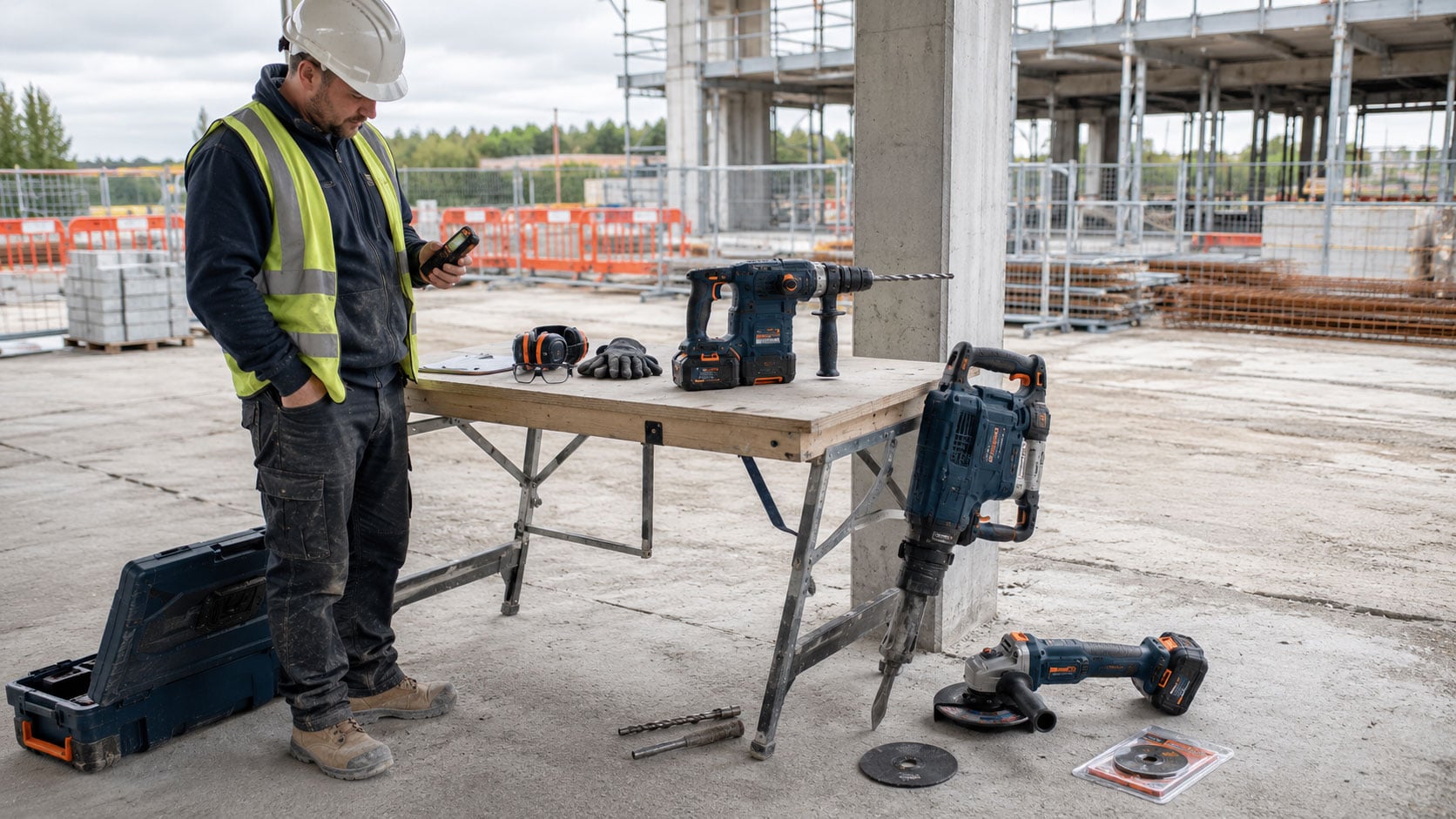
If you've ever used a breaker, grinder or SDS hammer over the course of a whole shift, you'll be aware of the toll that vibration takes long after the tool itself has been turned off. Vibration isn't an on/off issue – it depends on the level of vibration, the duration of the trigger operation, and the frequency of both.
In a trade that relies on vibrating tools being used constantly throughout the working day, this can add up to a significant risk very quickly.
Understanding Hand-Arm Vibration Exposure
Vibration travels from the grip of a vibrating powered tool through the hands and wrists. Short-term use is far from the same thing as using the tool repeatedly, day after day, as part of a job. Vibration exposure doesn't get reset with each job – it accumulates over the duration of every vibration-powered tool that gets used in a shift, so a day of drilling followed by one of grinding is greater than the total exposure from either.
The amount of vibration depends on vibration magnitude, trigger time, tool condition and working method. There are workplace exposure limits and action values specified by health and safety law in the UK, and regular work with high-vibration equipment is exactly the kind of activity they regulate.
| Factor | Why It Matters |
|---|---|
| Vibration level | Higher vibration leads to increased exposure more quickly |
| Trigger time | Exposure depends on operating time |
| Tool condition | Poorly maintained tools may increase vibration |
| Working method | Incorrect technique makes the task more difficult |
| Tool choice | A tool may be better suited for the job |
Which Tools and Jobs Increase Vibration Exposure the Most?
Some tools and activities increase vibration exposure more than others, and it's useful to know what those are.
Breaking/Demolition
Breakers, demolition hammers and heavy-duty rotary hammers produce the highest vibration levels in the construction and demolition sectors. Breaking, especially on old or reinforced concrete, increases vibration exposure rapidly.
Drilling into Concrete & Masonry
SDS drills and rotary hammers that are used multiple times in the day for drilling and light chiselling add up to increase daily exposure. It's more pronounced in cases of multiple holes to drill.
Grinding and Cutting
Angle grinders and similar equipment vibrate significantly less than breakers. However, prolonged surface preparation will still lead to increased vibration exposure.
Other Power Tool Tasks
Short jobs involving an impact driver or multitool repeated several times per day add up to total vibration exposure, not individual job exposure.
Selecting Tools That Will Reduce Your Vibration Exposure
Modern power tools offer much more advanced designs than they did in the past, and tool choice becomes a part of an effective vibration management strategy. Anti-vibration handles, internal dampening, improvements in motor technology and better ergonomics all decrease vibration that reaches the hands, while weight balance and improved design make holding and bracing easier.
Certain electronic control systems ensure smoother energy delivery compared to sharp bursts of power. It doesn't mean that the most expensive tool will be the most vibration-safe one. Rather, the correct choice lies in the suitability of the tool to the particular job, because a well-balanced breaker operated properly may cause the operator to experience less vibration than an unsuitable tool pushed through the job.
Why Faster Work Results in Reduced Vibration Exposure
Trigger time matters when calculating vibration exposure, not the time required to perform the task. A properly chosen rotary hammer, fitted with sharp SDS bits, will be able to perform a task significantly faster than a too-small and thus undersized drill operated beyond the comfort zone. Blunt or worn accessories decrease productivity and increase vibration exposure.
Drilling a dozen holes in hard concrete with the right-size SDS rotary hammer will take a much smaller part of the time compared to performing the task with the inappropriate tools. Buying based on price alone will lead to increased vibration exposure and decreased productivity.
Proper Tool Maintenance Helps with Vibration Control
The proper selection of the tools is a critical step. However, even the perfectly suitable tools will vibrate more if they are poorly maintained. Worn bearings, loosened parts, and damaged accessories all increase vibration output without visible changes in how the tool feels.
Blunt drill bits and dull accessories make the tool work harder, resulting in increased trigger time. All vibration damping components have to be checked regularly, since damage to these components removes all of the protection provided by the tool. Servicing the equipment according to the schedule and retiring the broken tool instead of pushing it to the end of the road is an important component of vibration management.
Safe Working Methods for High-Vibration Tools
Proper working methods also make the difference. Measure trigger time on high-vibration tools, rotate the high-vibration tasks between operators where possible, break up high-vibration tasks throughout the day instead of performing them continuously and don't grip harder than necessary, since the increased grip force transmits more vibration into the hands without improving results and adds to hand fatigue from power tools more generally.
Keep your hands warm and dry, follow the manufacturer's instructions and report any unusual increase in vibration. This doesn't replace a proper risk assessment of vibration exposure, and neither breaks nor task rotation can make excessive exposure acceptable.
Vibration Management as Part of the Normal Safety Procedures on Site
Vibration management works much better if it becomes a regular part of the job planning process, rather than something to think about when the problem emerges.
The right tool, fitted with the right accessory, well-maintained and used with correct techniques, combined with actual concern to trigger time, solves most of the vibration management problems on site.
No single feature can solve the problem alone. Better equipment and improved working techniques decrease vibration exposure.
FAQ's
Q1. What is hand-arm vibration?
A1. Hand-arm vibration is the vibration transmitted from vibrating tools to hands and arms. It can cause nerve, vascular and joint damage over time.
Q2. Which power tools cause the most vibration?
A2. Breakers, demolition hammers, rotary hammers and angle grinders produce the highest vibration levels, although lower-vibration tools also contribute to daily vibration exposure.
Q3. Does vibration reduction prevent HAVS?
A3. Anti-vibration technology decreases the vibration reaching your hands, although it doesn't remove the necessity of proper maintenance and working techniques.
Q4. Does the increased use of a power tool cause increased vibration exposure?
A4. Yes, because the vibration exposure is calculated on the basis of the trigger time and builds up for every vibration-powered tool used in the shift.
Q5. Do worn drill bits and accessories cause increased vibration?
A5. Blunt or damaged accessories cause tools to work harder and therefore increase vibration exposure, even on well-maintained tools.
Q6. What should I pay attention to when buying a low-vibration power tool?
A6. Vibration figures, anti-vibration technology, weight and balance and suitability to your workload.