

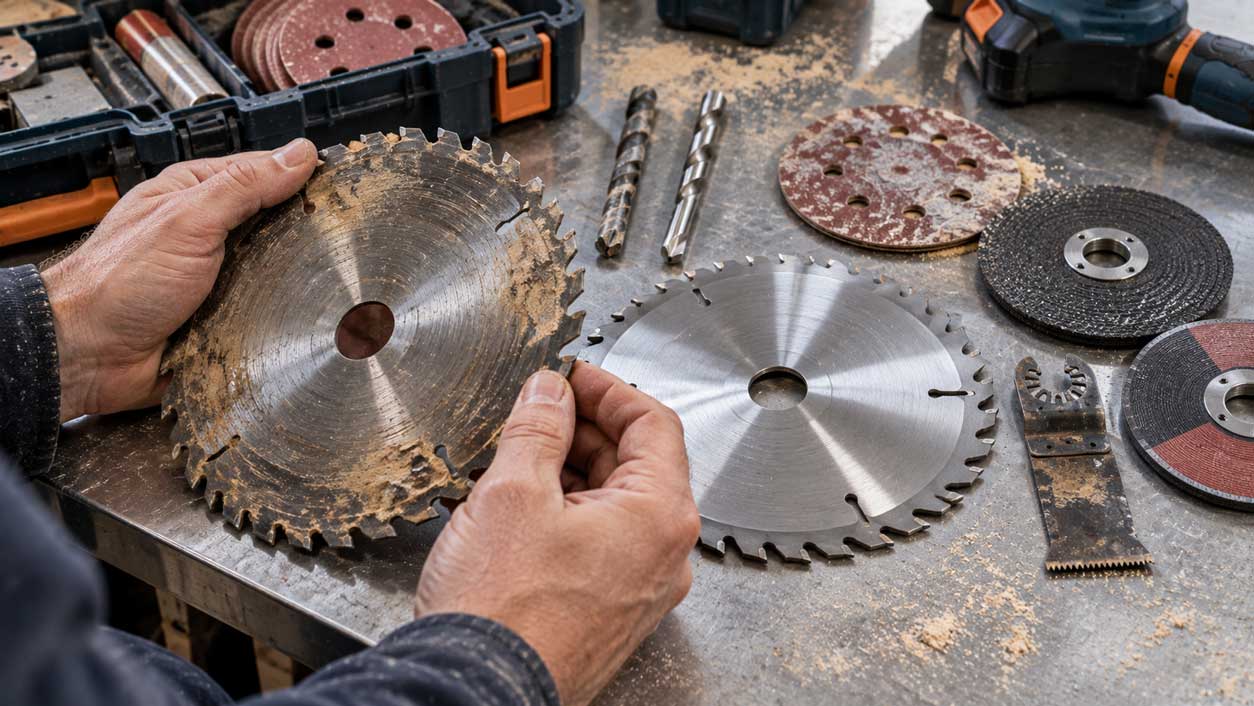
A circular saw that has been cutting through 18 mm ply boards effortlessly suddenly starts straining in the middle of the board. The drill that easily cut through the steel angle now requires your full weight to operate. A sanding disc is still mounted on the pad but does not do anything to the material. In cases like these, the tool is not always to blame while a change in accessory is more likely.
Blades, bits, discs and other accessories are consumable items. They do not necessarily need to become unusable to justify fitting new replacement blades. The best practice would be to inspect the accessory each time you notice some changes in the tool performance.
Why Worn-Out Accessories Impact Your Work
With time, the edge of the accessory becomes blunter and instead of cutting through the material, it scrapes through it. This means less speed, increased pressure needed to operate it, more heat generated, worse accuracy and lower quality of the cut. There may even be burning and increased vibration.
Extra pressure will hardly help you. Increased pressure only adds more heat to the process and makes the cut harder to control. It does not mean that you should replace an accessory right away as soon as you notice any drop in its efficiency. Change in performance is a good reason to examine the accessory.
The Main Indications That You Need to Examine Your Accessories
Taking more time, requiring increased pressure, not following a line, producing excessive heat, burning or making unusual noises are good reasons to stop the operation and inspect your accessories.
| Indication | What to Check |
|---|---|
| Longer cutting or drilling | Condition of the cutting edges and teeth or bits |
| Extra pressure is required | Sharpness and suitability for the material |
| Poor finish | Wear, damage or contamination |
| Burning and excessive heat | Condition of the cutting edge and the correct choice of accessory |
| Increased vibration | Damage, mounting and uneven wear |
Vibration, noise and visible damage are clear signs of damage and not normal wear. Stop the tool immediately and inspect the accessory.
How to Recognize the Worn-Out Saw Blades
Indications in Terms of Performance
The tired blade cuts slower and requires increased feed pressure. The cuts become rougher, plywood boards start to split and burn marks become apparent. It also becomes more difficult to keep the blade on a line.
Indications in Terms of Appearance
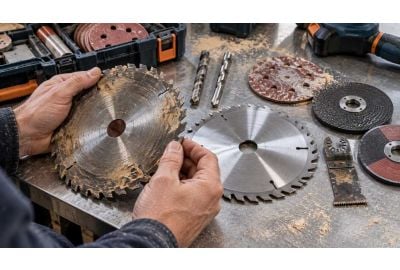
The most obvious physical signs include chipped or missing teeth, damaged carbide tips, distortion and cracks. Physically damaged blades should be removed from the saw.
Not every poor cut is caused by a dull blade. Accumulation of resin and pitch increases the friction and generates additional heat. Also, the blade choice, saw adjustment and the material should be checked as well.
How to Identify the Worn-Out Drill Bit
Longer operation time, additional pressure, skating before cutting and excessive heat are the main indications. In timber you will see the irregular and scorched entrance holes. In steel, the worn-out HSS bit squeals and produces fine fragments instead of steady swarf. The masonry bit with a rounded carbide tip polishes the hole instead of cutting it.
When the bit has been performing well on the same material but suddenly stops doing it, check the accessory first instead of assuming that the drill is not powerful enough. Some bits, especially HSS twist drills, can be professionally sharpened.
How to Know When the Cutting and Grinding Discs Should Be Changed
As they are used, the discs lose their diameter and, with it, their efficiency. This is normal wear and tear. Chipping, cracking and contamination are damage, and any damaged disc should not be used.
Discs that have been rattling in the van can be damaged as well. Inspect all discs that have been dropped or kept loose. Bonded discs have expiry dates, so if a disc operates poorly, it might be simply out of date. The limits of wear of the specific disc can be found in the manufacturer's instructions.
Indications of a Worn-Out Sanding Abrasive
Even when the disc is already useless as an abrasive, it can be still attached to the sander. Increased processing time, uneven results, bald patches, torn backing and additional heat are the indicators.
Clogging of the disc is a different story. The dust, paint or resin that blocks the grits gives a feeling of a used disc while the abrasive underneath is still sharp. Sometimes choosing the wrong grit can give a feeling that the disc has become worn out, so choose sanding and grinding abrasives.
Multi Tool Blades, Hole Saws and Other Consumable Accessories
Multi Tool Blades
Slow cuts during the plunge and deteriorating cut edge, wear and breaks of teeth and additional heat are typical signs.
Hole Saws
Dull teeth indicate a slow cutting and a ragged hole. Clean the slug before assessing the condition of the teeth.
Router Cutters and Other Cutting Accessories
Poor finish and increased resistance, deterioration of the edge are the indicators. However, sometimes resin clogging can have the same effect.
Is the Problem Caused by the Worn-Out Accessory?
Poor performance does not necessarily mean that the accessory has reached the end of its lifespan. Check the following first.
| Question | Why This Matters |
|---|---|
| Is the accessory suitable for the material? | Even sharp accessory cannot work properly if it is not designed for certain material |
| Is the accessory installed correctly? | Incorrect mounting leads to vibration and wandering cuts |
| Is the setup of the tool appropriate? | Speed, orbit or pendulum action influence the performance |
| Is contamination the cause? | Cleaning can help to restore performance |
| Is the workpiece adequately supported? | The movement results in pinching and rough edges |
| Are there signs of wear or damage? | Only in this case the accessory should be replaced |
A sharp, coarse ripping blade will still produce a ragged edge when applied to the melamine-faced board, as it was never designed to do this cut. Rebuying the same blade will not help. The solution is to choosing the right saw blade for the material.
When Is Sharpening Better Than Replacing?
Some accessories such as TCT saw blades, router cutters and HSS drill bits can be professionally sharpened. However, the decision to do so depends on the quality of the accessory, its original condition and wear. It is more reasonable to sharpen a premium blade than a budget one.
The difference between wear and damage should be considered. Blunt accessory with all teeth still intact can be sharpened. On the contrary, a blunt accessory with chipped, cracked or distorted teeth should not be reattached to the tool.
The Importance of Proper Spare Parts Stocking
Running into the situation where you find that the last remaining usable disc has been lost while using a run of steel is an easy way to spend an extra hour. Carry spares of the most commonly used items, such as drill bits, saw blades, cutting discs, multi tool blades and sanding abrasives. It is unnecessary to stock all available accessories.
How Often Do You Need to Replace the Accessories
There are no universal rules regarding replacement interval. It depends on the material the accessory is used with, how frequently it is used, its construction and quality, application and working conditions.
Notice changes in the performance of the accessory, inspect the accessory, identify the problem, clean or sharpen the accessory if possible and replace if it is worn or damaged. Detecting wear in time allows you to maintain your speed and accuracy and ensures proper tool performance.
FAQ's
Q1. How do I know if a saw blade is blunt?
A1. Slow cuts, increased feed pressure, burning and rough edges are the typical signs. The accumulation of resin or wrong choice of the blade are also able to give the same effect.
Q2. Should I replace a drill bit if it gets hot?
A2. No, it is not always necessary. Heat can be caused by the worn-out bit, but also by the excessive speed, additional pressure, lack of cutting fluid in metal or wrong type of the bit.
Q3. Can blunt accessories damage my tools?
A3. Blunt accessory puts an additional burden on the tool and increases heat. It does not necessarily mean that the tool will be damaged, but there is no point in operating a blunt accessory.
Q4. Can blades and drill bits be sharpened?
A4. Yes, many can be. Most popular examples are TCT saw blades and HSS drill bits. However, sharpening is possible only in case the accessory is not damaged and is reasonable in terms of costs.
Q5. When should I replace a cutting or grinding disc?
A5. If the accessory has reached the limit of wear according to the manufacturer's recommendations or if you have noticed deterioration of its performance. Replace any disc immediately if it is chipped, cracked, contaminated or expired.
Q6. Is it worth keeping the spares of my accessories?
A6. Yes, for the most commonly used accessories. The spare blade, bit or disc in your van will save you from interrupting your work or making an extra trip to the merchant.