


What Is Diamond Core Drilling?
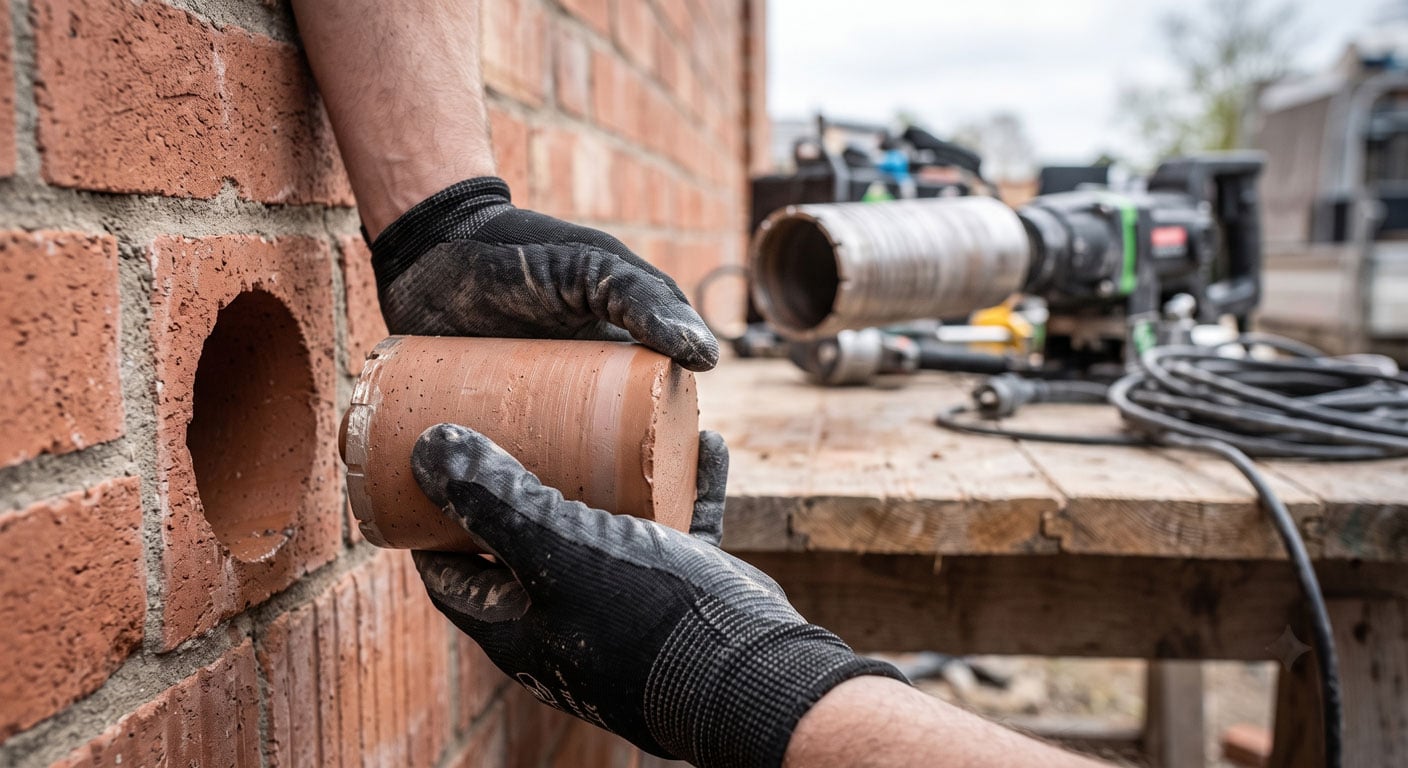
Diamond core drilling is a precision method for creating clean, accurately sized circular openings through brick, blockwork, concrete and natural stone. Rather than breaking material apart with hammer action, a diamond core drill rotates a hollow steel barrel fitted with diamond segments that grind away only the outer circumference of the hole, leaving a solid core inside.
The result is a clean, accurate hole with minimal breakout and less disturbance to the surrounding structure. It's the preferred method for boiler flues, ventilation ducts, waste pipes, electrical containment and other service penetrations. Professional contractors can explore the full range of Eibenstock diamond core drilling tools, built for everyday dry drilling through to demanding wet drilling and Soft Impact applications. As the metal bond holding the diamonds wears away, fresh diamonds are continually exposed, keeping the core cutting efficiently.
Many drilling problems stem not from the drill itself, but from using the wrong core bit, method or technique.
Diamond Core Drilling vs SDS Drilling
How the Two Methods Differ
An SDS drill removes material by combining rotation with rapid hammer blows, and is ideal for fixing holes, chasing channels and light demolition. Diamond core drilling instead grinds through only the circumference of the hole, giving cleaner edges, greater accuracy, less vibration, less risk of damaging surrounding masonry, and less making good afterwards.
Why Diamond Core Drilling Is Faster on Larger Holes
Where the difference really shows up is speed, and it's most dramatic on larger diameters. An SDS drill has to break out the entire cross section of a hole, which means repeatedly hammering, chiselling and clearing debris across the full area. As hole diameter increases, the volume of material that has to be broken out grows fast, and so does the time it takes. A diamond core drill only has to cut the thin circumference of the hole. The core itself simply lifts out as one solid piece, so the time required scales far more gently with diameter. On a 150 mm or larger opening, this difference can mean a diamond core drill finishing the hole in a fraction of the time an SDS approach would take, especially in dense masonry or concrete where hammer drilling slows dramatically as bit wear and material resistance increase.
Labour and Cost Savings
That speed advantage compounds directly into labour and job cost savings. Faster holes mean less time paying an operative to stand at a single penetration, less time spent on repeated repositioning and overlapping strikes, and less time on the making good and cleanup that follows a rougher SDS cut opening. On jobs with multiple holes, such as service risers, plant rooms or multiple flue and duct penetrations on a single site, these savings per hole add up quickly across the day. A contractor using the right diamond core drill and bit for the material can often complete significantly more penetrations in a single shift than would be possible with SDS drilling alone, improving day rate productivity and making it easier to hit tight programme deadlines without adding labour.
Fewer Errors and Less Rework
The efficiency gain isn't only about raw cutting speed either. Because diamond core drilling produces a clean, accurately sized hole in one pass, there's far less rework: no oversized or ragged openings to patch, no repeated attempts to true up a hole that's wandered off centre, and less risk of having to isolate services or protect finishes from flying debris. Combined with lower vibration and reduced operator fatigue, this lets contractors sustain a faster pace for longer, particularly on larger or repetitive drilling programmes.
When SDS Still Wins
None of this makes SDS drilling obsolete. For small fixing holes, chasing and light demolition it remains the faster, simpler tool. But for medium and large diameter penetrations, especially in concrete, reinforced concrete or dense masonry, diamond core drilling is consistently the quicker and more cost effective method once labour time, rework and job throughput are taken into account.
A 127 mm boiler flue opening made with an SDS drill usually needs numerous overlapping holes before breaking out the centre; a correctly matched core drill and bit produce the same opening in a single, cleaner operation, often in a fraction of the time. The two methods complement each other. The right choice depends on material and hole size.
Why Different Materials Need Different Methods
How Materials Affect Drilling
Standard facing brick drills easily with a quality dry diamond core. Engineering brick is denser, generating more heat and raising the risk of glazing. Tondu, Ruabon and Staffordshire Blue brick are more demanding still. Extra pressure only increases heat and shortens core life. Concrete brings hard aggregate and reinforcing steel that generate considerable heat, making water cooling essential. Natural stone varies too. Soft sandstones drill easily, while dense granites and engineered stone need different techniques.
Purpose Built Technologies
This is why Eibenstock developed several specialist technologies rather than one machine for every job. Dry drilling suits heating engineers, plumbers and electricians working brick and blockwork where water isn't practical. Wet drilling cools segments and flushes slurry when cutting concrete and reinforced concrete. Soft Impact fills the gap for dense engineering bricks that glaze conventional dry cores, introducing a controlled impact without the aggressive percussion of an SDS drill. Combination systems give contractors moving between masonry, stone and concrete the flexibility to handle both wet and dry work with one machine.
Matching Drills and Core Bits
Core selection matters as much as drill choice: dry cores suit masonry, wet cores suit concrete and stone. Laser welded segments offer excellent durability, and the right segment bond ensures fresh diamonds are exposed at the right rate. Too hard a bond glazes, too soft wears prematurely.
Recommended Pairings
| Material | Recommended Drill | Recommended Core |
|---|---|---|
| Standard brick | Dry core drill | Dry diamond core |
| Engineering brick | Soft Impact drill | Premium dry core |
| Tondu / Ruabon brick | Soft Impact drill | Laser welded dry core |
| Staffordshire Blue Brick | Soft Impact drill | Hard masonry core |
| Concrete block / Celcon block | Dry core drill | Standard dry core |
| Natural stone | Combination or wet drill | Stone specific core |
| Concrete | Wet drill | Wet core |
| Reinforced concrete | Wet drill or drill rig | Reinforced concrete core |
Correct matching improves drilling speed, extends core life and reduces operator fatigue.
When a Core Glazes
A glazed core can slow dramatically even when it looks fine. This is a sign that Soft Impact, not extra pressure, is the fix for dense fired clay masonry. Concrete and reinforced concrete should still use dedicated wet drilling systems.
When You Need a Drill Rig
Handheld drilling suits most service penetrations, but larger diameters and reinforced concrete often justify a rig, which keeps the drill aligned, improves accuracy and maintains consistent pressure. This is particularly valuable for large diameter cores, deep drilling, repetitive work and commercial or structural jobs.
Choosing the Correct Core Diameter
| Core Diameter | Typical Application |
|---|---|
| 32 mm | Small cable runs |
| 52 mm | Pipework and conduits |
| 65 mm | Waste pipes |
| 82 mm | Ventilation |
| 107 mm | Extractor fans |
| 127 mm | Domestic boiler flues |
| 152 mm | Commercial flues |
| 202 mm | Large ventilation/service penetrations |
Common Problems and Solutions
| Problem | Cause | Solution |
|---|---|---|
| Slow drilling | Wrong core, glazing or excess pressure | Match core to material; dress glazed segments |
| Core glazing | Hard masonry | Use Soft Impact or dress the core |
| Overheating | Poor cooling | Use water where appropriate |
| Barrel grabbing | Excessive pressure | Reduce pressure, keep drill square |
| Wandering hole | Poor starting technique | Start slowly until the core establishes its cut |
| Premature wear | Incorrect core | Select correct specification |
| Dust buildup | Poor extraction | Use suitable dust extraction |
Experienced contractors let the diamonds do the work rather than forcing the drill. Excessive pressure only creates more heat and wear.
Technique and Maintenance
Start every cut slowly until the barrel establishes a groove, then apply steady pressure, keeping the drill square and easing off near breakthrough to limit breakout. Use dust extraction during dry drilling and a consistent water supply during wet drilling. Afterwards, clean the core, inspect segments for damage, and store it so the cutting edge isn't knocked. If glazing occurs, dress the segments with an abrasive block before assuming the core needs replacing.
Choosing the Right Equipment
The best system is the one matched to your most common work. Heating engineers, plumbers and electricians working mainly in brick and blockwork will usually benefit from a dedicated dry drilling system; those regularly hitting engineering brick or dense masonry should consider Soft Impact. Builders and commercial installers drilling concrete and reinforced concrete need dedicated wet drilling systems, and a drill rig adds control for large, repetitive or highly accurate work. Matching drill, core and method to the material, rather than simply choosing the most powerful machine, delivers cleaner holes, longer core life and better performance.
Frequently Asked Questions
Q1. Can I use a diamond core drill in hammer mode?
A1. No. Diamond core drilling relies on rotational cutting; Soft Impact is purpose built for compatible masonry.
Q2. Can I drill reinforced concrete dry?
A2. Generally not. Wet drilling provides the cooling concrete and reinforcing steel need.
Q3. Why has my core stopped cutting?
A3. Usually glazing, excessive pressure, or using the wrong core for the material.
Q4. Do I always need water?
A4. No. Most brick and blockwork work is designed for dry drilling.
Q5. Can one drill handle every application?
A5. Combination drills offer good versatility, but the method and core bit must still match the material.